Perpetual futures allow traders to speculate on cryptocurrency prices without directly owning the underlying asset or worrying about a contract expiration date.
They are widely used in crypto derivatives trading, but their flexibility comes with additional risks. Unlike spot trading, perpetual futures involve margin requirements, funding payments, and the possibility of liquidation.
Understanding how these contracts work is essential before comparing crypto futures exchanges.
What Are Perpetual Futures?
A perpetual futures contract, often called a perp, is a derivative that tracks the price of an underlying asset, such as Bitcoin (BTC) or Ethereum (ETH), without having a scheduled expiration date.
Traditional futures contracts typically expire on a specified date. Perpetual futures, by contrast, allow traders to maintain a position as long as they satisfy the exchange’s margin requirements.
Traders can take either of two positions:
- Long: A position that generally profits when the underlying asset’s price rises.
- Short: A position that generally profits when the underlying asset’s price falls.
For example, a trader who expects Bitcoin to rise may open a BTC perpetual long position. Another trader who expects a decline may open a short position.
Neither position necessarily requires the trader to own Bitcoin in the spot market.
How Do Perpetual Futures Work?
Perpetual futures operate through several mechanisms that distinguish them from traditional spot trading.
1. No Expiration Date
Perpetual contracts do not have a scheduled expiry.
This eliminates the need to roll positions into new contracts as expiration approaches.
However, a position can still be closed voluntarily, liquidated when margin requirements are breached, or affected by exchange-specific contract termination rules.
2. Leverage and Margin
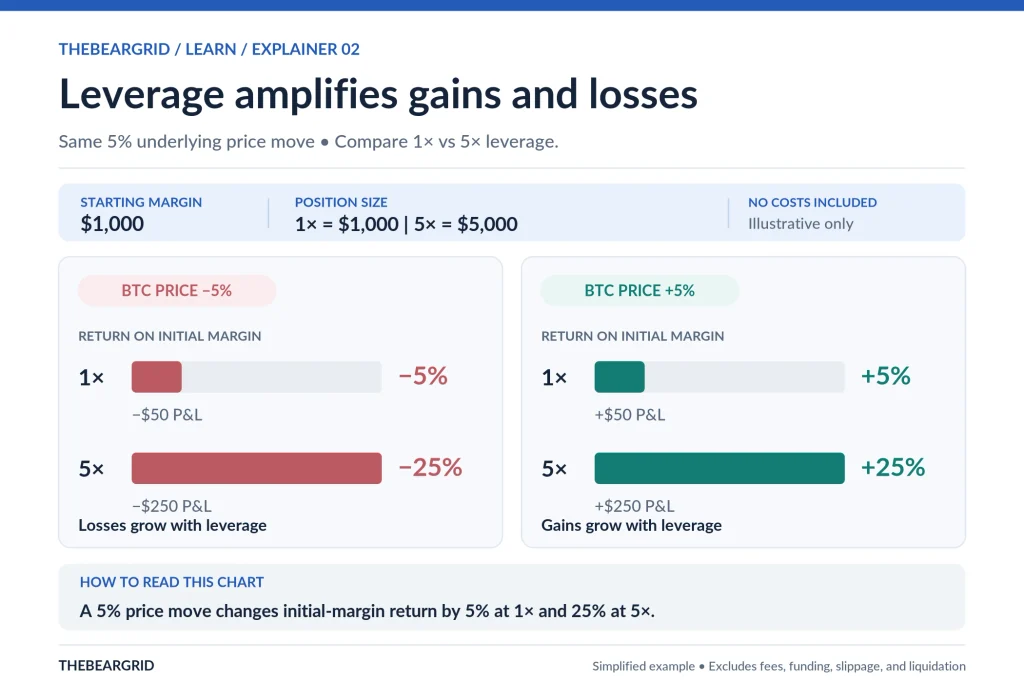
Perpetual futures allow traders to control a position larger than their initial margin.
Consider a simplified example:
- Initial margin: $1,000
- Leverage: 5x
- Position value: $5,000
A 5% favorable move in the underlying price would produce approximately $250 in profit, before trading costs and funding.
A 5% unfavorable move would instead produce approximately $250 in losses.
That represents a 25% gain or loss relative to the initial $1,000 margin.
Leverage magnifies both gains and losses. Higher leverage also reduces the price movement a position can generally withstand before liquidation.
Actual liquidation thresholds depend on maintenance margin, mark prices, fees, margin mode, and exchange rules.
3. Funding Rates
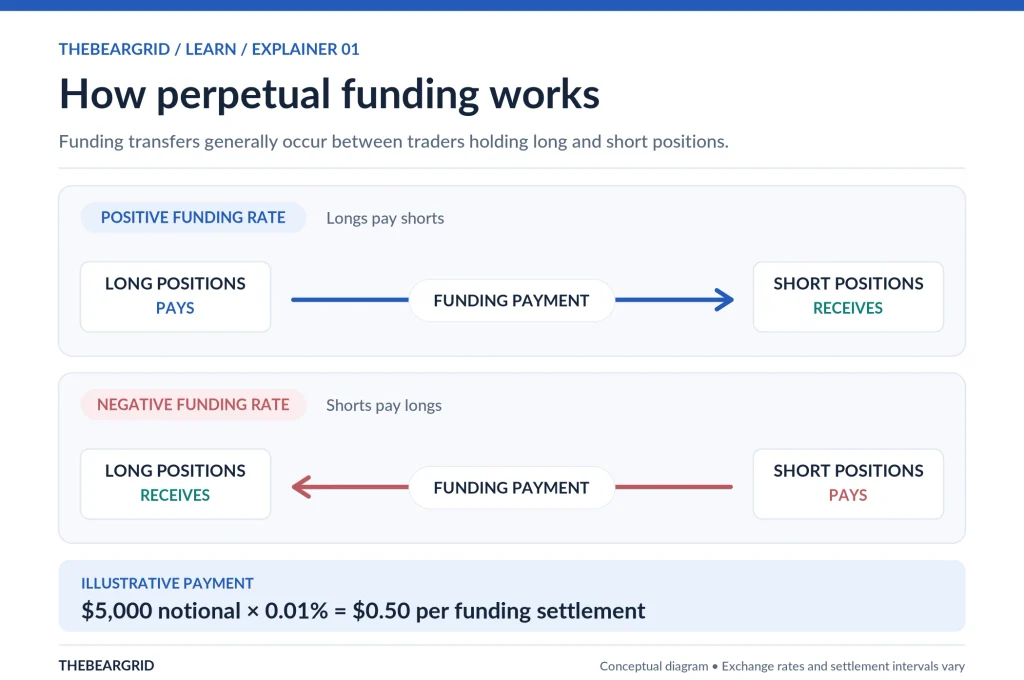
Funding is one of the defining features of perpetual futures.
Because perpetual contracts do not expire, exchanges use funding mechanisms to help keep their prices aligned with the underlying spot market.
Funding payments are generally exchanged between long and short position holders.
| Funding rate | Who pays? |
|---|---|
| Positive | Long positions pay short positions |
| Negative | Short positions pay long positions |
| Zero | No funding payment at that settlement |
Consider a trader holding a $5,000 BTC perpetual position with a positive funding rate of 0.01%.
The funding payment would be:
$5,000 × 0.01% = $0.50
In this example, the long position pays approximately $0.50 at the relevant funding settlement.
Funding rates are not fixed. They can change with market conditions, and the settlement frequency differs across exchanges and contracts.
A trader holding a position over an extended period may pay or receive multiple funding payments.
Therefore, comparing perpetual futures exchanges requires looking beyond trading fees.
4. Mark Price and Liquidation
Crypto exchanges generally use a mark price mechanism when assessing unrealized profit and loss and liquidation risk.
The mark price is a calculated reference price designed to reduce the influence of abnormal or temporary trading-price movements.
If a leveraged position no longer satisfies the required maintenance margin, the exchange may initiate liquidation.
Liquidation can close all or part of a position, depending on the exchange’s risk-management rules.
It is important to understand that a position can be liquidated before the underlying asset moves by the full percentage implied by its nominal leverage.
Perpetual Futures vs. Spot Trading vs. Traditional Futures
Although these instruments can provide exposure to the same underlying asset, they function differently.
| Feature | Spot Trading | Perpetual Futures | Traditional Expiry Futures |
|---|---|---|---|
| Direct asset ownership | Generally yes | No | No |
| Scheduled expiration | No | No | Yes |
| Long exposure | Yes | Yes | Yes |
| Short exposure | Requires additional arrangements | Yes | Yes |
| Leverage | Usually none without margin borrowing | Often available | Often available |
| Periodic funding payments | No | Usually yes | No perpetual-style funding |
| Liquidation risk | Not for fully funded spot holdings | Yes, with margin | Yes, with margin |
The distinction matters because holding a perpetual futures position is not equivalent to holding the underlying cryptocurrency.
Even if the market price remains relatively stable, funding payments and trading expenses can affect the outcome of a leveraged position.
Why Do Traders Use Perpetual Futures?
Perpetual futures are commonly used for several purposes.
Directional trading: Traders can take long or short positions based on their expectations for future price movements.
Hedging: Investors holding spot cryptocurrency may use short perpetual positions to offset part of their exposure.
Capital efficiency: Margin allows traders to obtain larger market exposure with less initial capital, although doing so increases risk.
Relative-value strategies: Some traders analyze differences between spot and perpetual prices or funding rates. These approaches can still involve substantial execution, funding, liquidity, and counterparty risks.
None of these uses removes the possibility of significant losses.
What Should Traders Compare Across Crypto Futures Exchanges?
Not all perpetual futures markets are identical.
Two exchanges may list the same BTC perpetual contract but offer materially different trading conditions.
Before choosing an exchange, traders should evaluate several factors.
Trading Fees
Maker and taker fees affect the cost of opening and closing positions.
Frequent traders should consider the combined effect of entry fees, exit fees, and other applicable charges.
Funding Rates and Intervals
Funding rates and settlement schedules can differ between exchanges and trading pairs.
A platform with low trading fees does not necessarily offer the lowest total cost of holding a perpetual position.
Liquidity and Slippage
Order-book depth, bid-ask spreads, and execution quality matter, particularly for larger orders or during volatile market conditions.
Reported trading volume alone does not establish execution quality.
For a data-based view of where derivatives trading activity was concentrated, see our September 2026 crypto derivatives exchange market share report, covering 11 tracked exchanges.
Available Contracts
Exchanges differ in their supported assets, settlement currencies, collateral options, and contract specifications.
Some focus heavily on major cryptocurrency contracts, while others offer broader derivatives markets.
Risk Management
Maintenance margin rules, liquidation mechanisms, mark-price calculations, and supported margin modes can vary.
Understanding these differences is especially important for leveraged trading.
Availability and Regulation
Derivatives products may be restricted or unavailable in certain countries or regions.
Traders should verify whether the relevant platform and product are legally available to them before opening an account.
Risks of Trading Perpetual Futures
Perpetual futures carry risks that traders should not underestimate.
- Leverage risk: Small market movements can produce disproportionately large losses relative to posted margin.
- Liquidation risk: Positions may be forcibly reduced or closed when margin requirements are breached.
- Funding risk: Repeated funding payments can increase holding costs.
- Liquidity risk: Spreads and slippage may widen during volatile periods.
- Exchange and counterparty risk: Outages, operational failures, security incidents, or platform insolvency can affect access to funds and positions.
Using lower leverage, understanding margin requirements, and evaluating platform risk can reduce some exposures, but cannot eliminate trading losses.
FAQ
Do perpetual futures expire?
Standard perpetual futures do not have a scheduled expiration date. However, positions remain subject to margin requirements, liquidation rules, and possible contract termination by the exchange.
Do you own Bitcoin when trading BTC perpetual futures?
No. A BTC perpetual position generally provides derivative exposure to Bitcoin’s price rather than direct ownership of the cryptocurrency.
Are funding rates the same on every exchange?
No. Funding calculations, payment intervals, and applicable contract rules vary by exchange and product.
Can you lose money without a major price movement?
Yes. Funding payments, trading fees, spreads, and other expenses can reduce returns even when the underlying price changes relatively little.
Summary
Perpetual futures combine flexible long and short exposure with leverage and no scheduled contract expiration.
But their usefulness depends on understanding how funding, margin, liquidation, and execution costs interact.
For traders comparing crypto exchanges, the key question is not simply which platform offers the highest leverage or lowest advertised fees.
It is which exchange provides suitable trading conditions, liquidity, risk controls, and product availability for a particular trading need.
That distinction is central to evaluating the crypto derivatives market.
Disclaimer: This article is for informational and educational purposes only and does not constitute financial or investment advice. Cryptocurrency derivatives trading involves significant risk.