Crypto exchanges are competing for more than trading volume; they’re competing for the traders, liquidity, and capital that make their derivatives markets attractive in the first place.
For perpetual futures traders, the choice of exchange can affect almost every part of a trade—from execution prices and funding costs to margin efficiency and liquidation risk. That makes competition in the derivatives industry more complicated than a race to offer the lowest fees or the highest leverage.
Exchanges need to attract active traders, provide sufficient liquidity, introduce products people actually want to trade, and maintain the infrastructure needed to keep those traders on the platform.
The real question is which competitive advantages can translate into lasting trading activity.
The Competitive Landscape of Crypto Perpetual Futures
The derivatives market remains concentrated among a relatively small group of large exchanges.
According to CoinMarketCap Research, 11 tracked exchanges processed approximately $4.06 trillion in derivatives trading volume in September 2026. Binance accounted for 44.67% of that volume, followed by OKX at 17.49% and Bybit at 10.69%.
Together, the three exchanges represented nearly 73% of derivatives volume in the tracked sample.
But the rankings weren’t completely static. Gate gained 2.19 percentage points of market share from August, while MEXC lost 3.61 percentage points.
These movements illustrate an important distinction: a large trading venue can maintain a strong overall position while smaller competitors gain or lose ground over relatively short periods.
The figures don’t tell us exactly why traders moved, or whether the changes reflect lasting shifts in customer preference. Market volatility, product activity, and changes in trading behavior can all affect the rankings.
Still, they provide a useful starting point for understanding the competitive landscape.
For the full dataset and exchange rankings, see our September 2026 Crypto Derivatives Exchange Market Share report.
Liquidity: The Most Important Competitive Advantage?
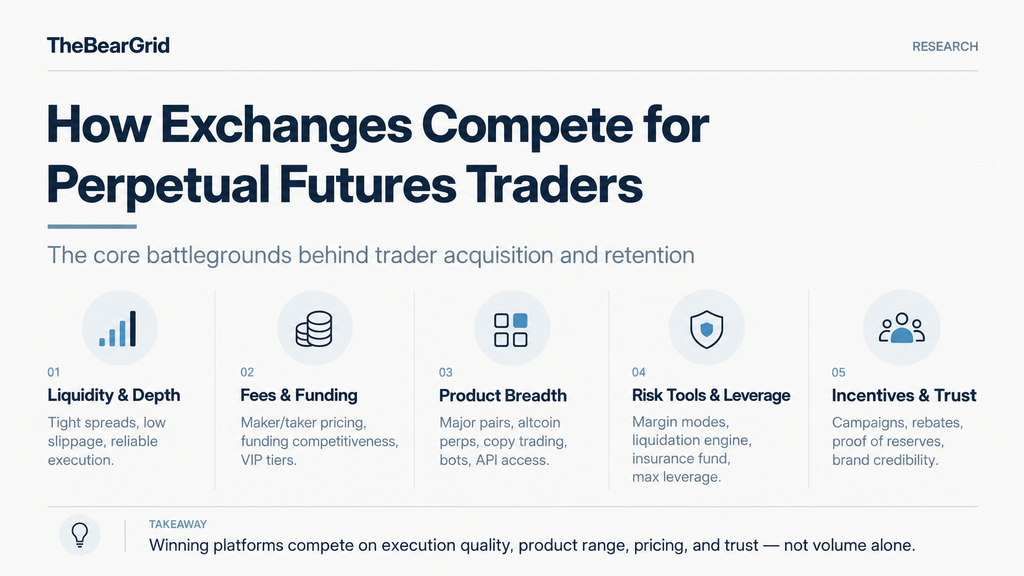
One of the strongest advantages a derivatives exchange can develop is a liquid market.
Traders generally want to enter and exit positions quickly without moving prices significantly against themselves. For that to happen, an exchange needs active buyers and sellers, sufficient order-book depth, and competitive bid-ask spreads.
This creates a self-reinforcing dynamic: an exchange with consistently strong liquidity can attract more traders, which in turn may encourage market makers to provide deeper liquidity. This cyclical improvement in execution conditions can draw further participation.
The primary challenge for smaller exchanges is breaking into this established cycle.
Trading Volume Doesn’t Tell the Whole Story
High trading volume is useful evidence of market activity, but it isn’t a complete measure of liquidity.
Two exchanges could report similar BTC perpetual futures volumes while offering very different execution conditions for a large market order.
A trader placing a $100,000 order may care much more about the available order-book depth and expected slippage than about the exchange’s headline daily trading volume.
That distinction becomes even more important during volatile periods, when liquidity can disappear quickly and spreads may widen.
When evaluating liquidity competition, we should look beyond volume rankings and consider:
- Bid-ask spreads
- Order-book depth at comparable price distances
- Slippage for standardized order sizes
- Execution quality during volatile market conditions
- Liquidity consistency across different trading pairs
The competitive advantage isn’t simply having more transactions. It’s being able to execute trades efficiently when customers need it.
Trading Fees: The Price Competition That Traders Notice First
Fees are one of the most visible ways exchanges compete.
Most perpetual futures platforms use maker and taker fee structures, with different rates depending on factors such as trading volume, account tier, or applicable promotions.
For active traders, even small differences can add up.
Consider a simplified example involving a $50,000 perpetual futures position.
A difference of 0.02 percentage points in the trading fee amounts to $10 for a single execution at that notional value.
If the same difference applies when both opening and closing the position, the total difference reaches $20, assuming unchanged notional size.
For someone trading frequently, those costs matter. But lower advertised fees don’t necessarily translate into cheaper trading.
The Real Competition Is Total Trading Cost
Execution prices are just as important as commissions.
An exchange offering lower taker fees may still be more expensive if the same order experiences significantly greater slippage.
Likewise, an exchange with a more expensive headline fee schedule may provide better overall execution for certain order sizes or trading pairs.
This is why fee comparisons should be made alongside liquidity conditions rather than treated as a separate ranking.
There’s also an important limitation to fee-based competition.
Discounts can attract trading activity, particularly from price-sensitive or high-volume participants. But sustaining that activity may require exchanges to maintain both competitive prices and a reliable trading environment.
Winning traders through lower fees is one thing; keeping them after the promotional advantage disappears is another.
Funding Rates: A Different Kind of Trading Cost
Trading commissions are only part of the cost of maintaining a perpetual futures position.
Funding payments can also affect returns, particularly for traders holding positions across multiple settlement periods.
Unlike ordinary trading commissions, funding payments are generally exchanged between long and short position holders.
When the funding rate is positive, longs pay shorts; when it is negative, shorts pay longs.
The rate itself reflects market conditions and the contract’s funding mechanism, rather than being a simple fee that an exchange can lower at will.
However, exchanges can differ in their funding calculations, settlement intervals, and contract-specific rules.
For example, OKX uses an eight-hour funding schedule by default for many perpetual contracts, while certain products can settle more frequently. Hyperliquid generally settles perpetual funding hourly.
Different funding intervals do not necessarily mean higher or lower total funding costs. Traders should compare funding payments over equivalent holding periods rather than relying on settlement frequency alone.
These differences matter when traders compare the cost and operational requirements of holding positions.
An exchange that appears cheaper based on trading commissions alone may not provide the lowest total cost over a longer holding period.
The relevant comparison therefore depends on the contract, the funding environment, and the trader’s strategy.
For a detailed explanation of the underlying mechanics, see our guide to perpetual futures.
Margin Efficiency: Competing for Traders’ Capital
Another major area of competition is how efficiently traders can use their capital.
Perpetual futures require margin, but exchanges differ in how they manage collateral, unrealized profits and losses, and exposure across multiple positions.
For traders managing several markets at once, these differences can become more important than small fee discounts.
Some platforms offer cross-margin and multi-asset collateral arrangements, while more advanced account structures may support portfolio margining.
For example, OKX provides multi-currency and portfolio margin account modes that allow eligible collateral assets to support positions under the applicable risk rules.
These systems can improve capital efficiency for certain strategies, but they also introduce additional considerations.
Using several assets as collateral may expose a trader to collateral-price fluctuations, borrowing costs, and more complicated liquidation behavior.
A more flexible margin system isn’t automatically a safer one.
From an exchange’s perspective, however, better capital-management tools can make the platform more attractive to sophisticated and active traders.
This is particularly relevant for market makers, hedgers, and participants managing positions across multiple instruments.
The competition isn’t just about how much leverage an exchange offers; it’s about how effectively traders can manage their entire exposure.
Product Expansion: More Contracts, More Trading Opportunities
Liquidity and fees help determine where traders execute their orders.
Product availability helps determine why they visit an exchange in the first place.
Major perpetual futures platforms now compete across a much wider set of instruments than BTC and ETH.
Depending on the venue, traders may find perpetual contracts linked to large-cap cryptocurrencies, smaller tokens, and increasingly, traditional financial assets.
This expansion creates opportunities for exchanges to attract traders with different interests and strategies.
But listing more contracts doesn’t automatically make a platform more competitive.
New contracts need sufficient liquidity, credible pricing mechanisms, and risk controls that match the characteristics of the underlying market.
An exchange can offer hundreds of trading pairs while concentrating most of its meaningful liquidity in a relatively small number of them.
The Expansion Into Traditional Assets
One of the more interesting developments is the growing overlap between crypto derivatives infrastructure and traditional financial markets.
Some platforms have introduced perpetual-style exposure linked to equities, commodities, and other real-world assets.
Others are experimenting with new market structures that support additional asset types.
This development matters because exchanges are beginning to compete for trading activity beyond conventional cryptocurrency markets.
However, initial hype does not guarantee sustained demand.
In a clear example of this disconnect, CoinDesk Research reported that real-world asset (RWA) perpetual futures volume declined 19.8% month over month in September 2026, dropping to approximately $413 billion under its methodology.
This contraction following a period of expansion illustrates why new product categories must be evaluated by actual, sustained trading adoption rather than initial listing announcements alone.
The opportunity is significant, but the ability to sustain liquidity and trader interest will determine which new markets become meaningful businesses.
Risk Management: The Competition That Matters During Volatility
Traders tend to notice liquidity and fees when markets are functioning normally.
Risk-management systems become much more important when conditions deteriorate.
Perpetual futures exchanges operate liquidation engines, margin systems, and other mechanisms designed to manage the risks created by leveraged positions.
These mechanisms can differ materially between venues.
Areas worth comparing include:
- Mark-price and liquidation-price calculations
- Maintenance margin requirements
- Insurance-fund arrangements
- Auto-deleveraging rules
- Partial liquidation mechanisms
- Platform stability during heavy trading activity
For example, Bybit maintains insurance-fund mechanisms designed to absorb certain liquidation shortfalls and uses auto-deleveraging procedures when applicable risk conditions are met.
These mechanisms help explain how an exchange handles extreme events, but their existence alone doesn’t prove that one platform is safer than another.
A fair comparison requires examining the actual rules, transparency, operational history, and outcomes during stressed market conditions.
For a trader maintaining leveraged exposure, those details can matter far more than a temporary fee discount.
For exchanges, the challenge is maintaining enough confidence in their infrastructure to retain active participants through repeated market cycles.
CEX vs. DEX: A New Dimension of Perpetual Futures Competition
Competition is no longer limited to centralized exchanges.
Decentralized perpetual futures platforms have become an increasingly important part of the derivatives landscape.
Hyperliquid is one of the clearest examples of this development.
Its infrastructure supports on-chain perpetual futures order books and trading activity, offering a different model from the conventional centralized exchange.
The distinction matters because some traders value transparent on-chain activity and direct interaction with blockchain-based markets.
Others may prioritize familiar centralized account systems, integrated services, customer support, or specific market-access arrangements.
Neither model is universally superior.
Why Hyperliquid Matters
Hyperliquid’s approach extends beyond offering another trading interface.
Through its HIP-3 framework, builders meeting the protocol’s requirements can deploy perpetual markets under defined operational and collateral requirements.
That creates a different approach to expanding the range of available contracts.
Instead of relying exclusively on a centralized exchange’s internal listing decisions, market deployment can involve third-party builders operating within the protocol’s framework.
This introduces additional competition around market creation and distribution.
It also creates new questions about oracle design, market operations, liquidity, and risk allocation.
According to CoinDesk Research, decentralized futures trading reached approximately $627 billion in September 2026, accounting for roughly 13.7% of derivatives trading under its market-coverage methodology.
These CoinDesk estimates use a different market coverage and methodology from the 11-exchange CoinMarketCap sample discussed earlier, so their market-share figures should not be directly compared.
The figure doesn’t establish that decentralized venues are displacing centralized exchanges across the board.
In fact, the reported DEX derivatives share slipped slightly during the month.
But it does show that perpetual futures competition now extends beyond the traditional CEX landscape.
Regulation and Market Access: Competition Has Geographic Boundaries
An exchange may offer competitive fees, deep liquidity, and a wide product range, yet remain unavailable to traders in certain jurisdictions.
Access to perpetual futures depends on applicable regulations, product approvals, customer eligibility, and individual platform restrictions.
As the industry develops, regulatory positioning can affect which exchanges are able to serve particular customer groups and what products they can offer.
This creates a competitive dimension that trading-volume rankings often miss.
A platform with substantial global activity isn’t necessarily accessible or suitable for a trader in a particular country.
The geographic distribution of trading activity, the products available in each region, and the cost of maintaining regulatory compliance all shape exchange competition.
For traders, availability isn’t a secondary consideration. It is a prerequisite.
What Actually Determines an Exchange’s Competitive Position?
Looking across these factors, perpetual futures competition operates on several levels.
| Competitive Factor | What Traders Experience | What Matters for Analysis |
|---|---|---|
| Liquidity | Spreads, slippage, execution | Depth and execution quality |
| Trading Costs | Maker and taker fees | Total execution cost |
| Funding | Holding costs or payments | Funding rates and settlement rules |
| Margin System | Capital flexibility | Collateral efficiency and risk |
| Product Coverage | Available trading opportunities | Contract demand and liquidity |
| Risk Management | Liquidation and platform exposure | Rules, resilience, and transparency |
| Market Access | Product availability | Jurisdiction and eligibility |
No single metric captures all these dimensions.
Trading volume provides a useful measure of activity, but open interest, liquidity, and other indicators reveal different aspects of the market.
Even when an exchange gains market share, we need to distinguish between short-term trading activity and evidence of a sustained competitive advantage.
For example, a temporary surge in volume may reflect heightened volatility or a newly popular contract rather than a permanent migration of traders.
Likewise, an exchange can serve a narrower group of traders exceptionally well without challenging the largest platforms in total volume.
A rise in market share may signal stronger competitive positioning, but it doesn’t necessarily prove that traders are becoming more loyal to a platform.
Sustained liquidity, recurring trading activity, and resilience across market conditions offer a more useful test of whether those gains can last.
The strongest competitive position is not necessarily the highest ranking on a single leaderboard.
It is the ability to attract and retain trading activity while delivering consistent execution, useful products, and reliable market infrastructure.
What to Watch Next
Several developments will be worth following as perpetual futures competition evolves.
- Whether liquidity continues to concentrate on the largest platforms or becomes more distributed across specialized venues.
- Whether trading-cost competition translates into lasting increases in activity rather than temporary volume spikes.
- How new products—particularly perpetual contracts linked to traditional financial assets—perform after their initial launch periods.
- Whether decentralized platforms continue gaining relevance as alternative venues for trading, market creation, and liquidity provision.
- How regulatory developments reshape access to derivatives products across different regions.
These trends won’t necessarily move in the same direction.
An exchange could gain volume share while losing ground in a particular product category.
Another could expand its open interest or market-making activity without generating the same level of turnover.
That’s why evaluating exchange competition requires more than simply identifying the largest venue.
FAQ
Why do perpetual futures traders choose one exchange over another?
Traders may compare liquidity, execution costs, funding rates, available contracts, margin requirements, risk controls, and regional access. The importance of each factor depends on their trading needs.
Does the exchange with the highest trading volume have the best liquidity?
Not necessarily. Trading volume measures activity, while liquidity depends on factors such as order-book depth, spreads, slippage, and execution conditions.
Are decentralized perpetual exchanges replacing centralized exchanges?
Decentralized platforms have become meaningful competitors in some derivatives markets, but centralized exchanges continue to account for substantial trading activity. Market shares vary by data provider and measurement period.
Summary
Competition among crypto perpetual futures exchanges goes well beyond market-share rankings.
Large platforms benefit from established trading activity and liquidity, but challengers can compete through lower costs, specialized products, capital efficiency, and different market structures.
The emergence of decentralized perpetual markets and derivatives linked to traditional assets adds another layer to this competition.
Still, expanding product listings or offering aggressive trading incentives doesn’t automatically translate into a lasting advantage.
The more meaningful question is whether an exchange can consistently provide the conditions traders need—and retain that activity over time.
For TheBearGrid, this is the distinction worth tracking: market share shows where traders are active today, while liquidity, costs, product adoption, and risk management help explain which exchanges may remain competitive tomorrow.
Disclaimer: This article is for informational and educational purposes only and does not constitute financial or investment advice. Cryptocurrency derivatives involve significant risk. Product availability and exchange rules vary by jurisdiction.
References
- CoinMarketCap Research — September 2026 Exchange Monthly Report
- CoinDesk Research — September 2026 Exchange Review
- Kaiko — Understanding Centralized Exchange Liquidity Data
- Bybit — Trading Fee Structure
- Bybit — Funding Fee Calculation
- Bybit — Auto-Deleveraging Mechanism
- Bybit — Insurance Fund
- OKX — Perpetual Funding Fee Mechanism
- OKX — Multi-Currency and Portfolio Margin Modes
- Hyperliquid — Funding
- Hyperliquid — HIP-3 Builder-Deployed Perpetuals