Funding rates are one of the most important—and frequently misunderstood—features of crypto perpetual futures trading.
Unlike traditional futures contracts, perpetual futures have no fixed expiration date. Traders can maintain long or short positions without a scheduled contract maturity. But that flexibility creates a problem: without expiration, what keeps the perpetual futures price aligned with the underlying spot market?
The answer is the funding rate.
Understanding how funding works matters for more than calculating trading costs. Funding rates can also reveal how traders are positioning themselves, where demand for leveraged exposure is concentrated, and how expensive it has become to maintain a position.
Summary
- Funding rates are periodic payments between long and short positions, designed to help keep perpetual futures prices aligned with the underlying spot market.
- Positive funding means longs pay shorts; negative funding means shorts pay longs. The actual payment depends on position value, the applicable funding rate, and the settlement schedule.
- Funding rates provide useful information about market positioning, but they are not reliable standalone signals of future price direction.
What Is a Funding Rate in Crypto?
A funding rate is a percentage used to calculate periodic payments between traders holding opposing positions in a perpetual futures contract.
The mechanism exists because perpetual futures do not have an expiration date.
Traditional futures contracts generally converge toward their underlying reference price as expiration approaches. Perpetual futures do not benefit from that same scheduled convergence.
Instead, exchanges use funding payments to create an economic incentive for traders to keep perpetual contract prices relatively close to the underlying spot market.
When demand for long exposure pushes perpetual futures prices above the reference market, funding generally becomes more positive. Long traders then pay short traders, making it relatively more expensive to maintain long exposure.
When demand for short exposure pushes perpetual futures prices below the reference market, funding can become negative. Short traders then pay long traders.
These payments influence trading incentives rather than directly forcing prices to converge.
Importantly, funding is generally transferred between opposing position holders rather than collected by the exchange as a conventional trading fee.
For a broader explanation of how these contracts operate, see What Are Perpetual Futures?.
How Do Positive and Negative Funding Rates Work?
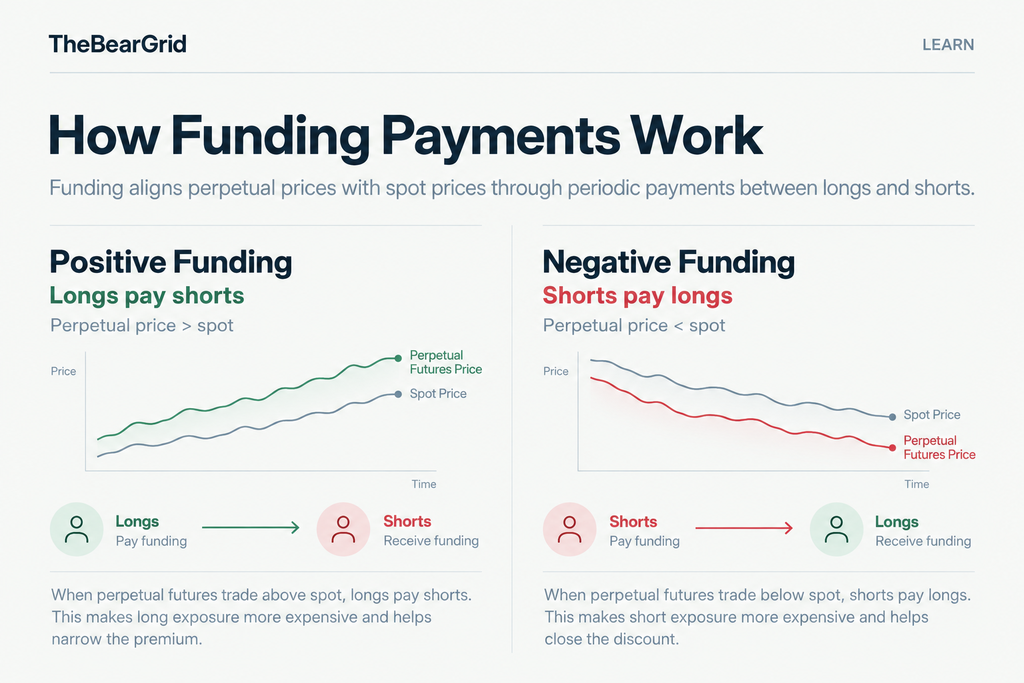
The direction of the funding payment depends on whether the funding rate is positive or negative.
| Funding rate | Long positions | Short positions | Typical interpretation |
|---|---|---|---|
| Positive | Pay funding | Receive funding | Stronger demand for long exposure |
| Negative | Receive funding | Pay funding | Stronger demand for short exposure |
| Zero | No funding payment | No funding payment | No funding transfer for that settlement |
Positive Funding Rates
Suppose Bitcoin perpetual futures are trading at a persistent premium to the underlying spot index.
This may reflect stronger demand from traders seeking leveraged long exposure.
A positive funding rate makes holding long positions more expensive while compensating traders on the short side.
The resulting incentive may attract additional short exposure or encourage traders to reduce expensive long positions.
That pressure can help narrow the difference between the perpetual and spot markets.
However, a positive funding rate does not necessarily mean that Bitcoin is about to decline.
During strong uptrends, positive funding may persist for extended periods because traders remain willing to pay for long exposure.
Negative Funding Rates
Now consider the opposite situation.
If demand for short exposure becomes sufficiently strong, perpetual futures may trade below their underlying spot reference.
Funding can turn negative, causing short traders to pay long traders.
This makes maintaining short exposure more expensive while compensating traders willing to hold long positions.
Persistent negative funding may indicate strong demand for bearish positioning, hedging, or short-side leverage.
It does not automatically predict a price recovery.
The funding rate reflects the economics of positioning, not a guarantee about the market’s next move.
How Are Funding Fees Calculated?
For a standard linear, stablecoin-margined perpetual futures contract, the basic calculation is straightforward:
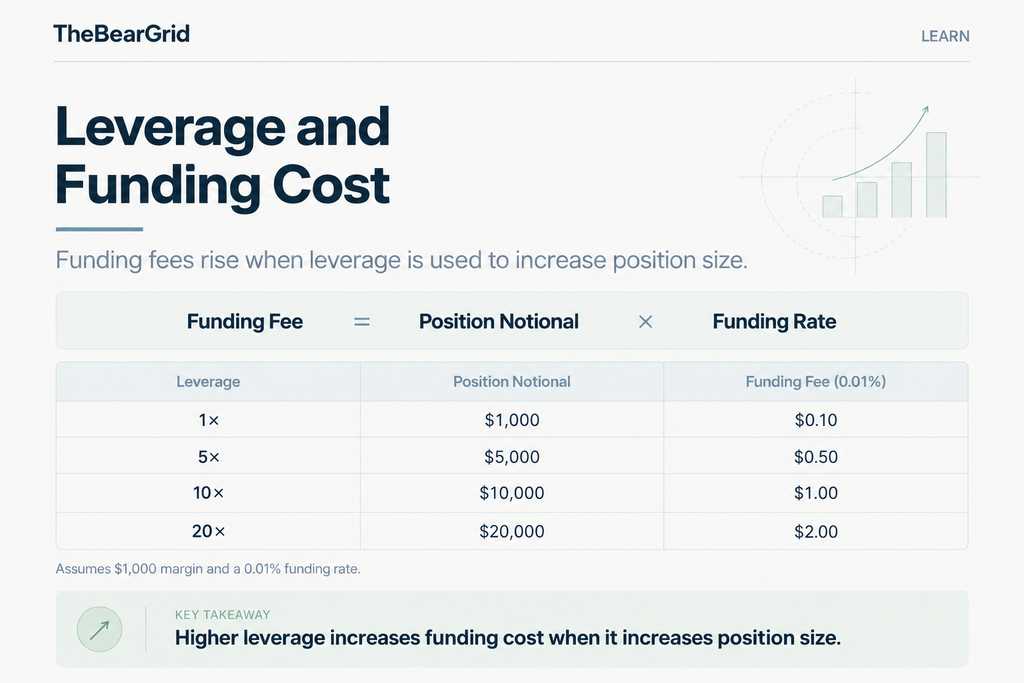
Funding Fee = Position Notional Value × Funding Rate
Position notional value is generally calculated using the contract quantity and the applicable mark price at settlement.
The exact calculation can differ for inverse contracts and other product structures.
Example: A $10,000 BTC Perpetual Position
Assume a trader holds a BTC perpetual futures position with the following characteristics:
| Variable | Value |
|---|---|
| Position notional value | $10,000 |
| Initial margin | $1,000 |
| Effective leverage | 10× |
| Funding rate | +0.01% |
| Funding interval | 8 hours |
The funding payment for one settlement is:
$10,000 × 0.0001 = $1
Because the funding rate is positive, a trader holding the long position pays $1 in funding.
A trader holding an equivalent short position receives $1 under the standard funding mechanism.
Now suppose the rate remains unchanged for three consecutive eight-hour settlements and the position value remains constant.
The long trader would pay:
$1 × 3 = $3 over 24 hours
This is a simplified illustration. Actual funding rates and position values can change between settlements.
What Happens When Funding Turns Negative?
Assume the same $10,000 position, but the funding rate changes to -0.02%.
The funding amount becomes:
$10,000 × 0.0002 = $2
In this case, the short position pays $2 and the long position receives $2.
The sign of the funding rate determines the direction of payment. The absolute size of the rate determines the payment relative to notional exposure.
Why Leverage Matters
One important distinction is that funding is calculated on the position’s notional value, not simply on the margin deposited to open it.
In the previous example, the trader posted $1,000 to control a $10,000 position.
A $1 funding payment represents:
- 0.01% of the position’s notional value.
- 0.10% of the initial $1,000 margin.
When traders increase leverage while keeping their initial margin unchanged, they can open larger positions, which results in higher funding fees.
For example, with $1,000 in margin and a funding rate of 0.01%, a 1× leveraged position incurs $0.10 in funding, while a 10× leveraged position incurs $1.00 per settlement.
However, funding fees are calculated based on position notional value, not leverage itself. If the notional value remains unchanged, increasing leverage alone does not increase the funding fee.
Leverage changes the relationship between the funding cost, committed margin, and liquidation risk.
When Are Funding Fees Paid?
Funding is settled according to a schedule defined by the exchange and the individual perpetual contract.
An eight-hour funding interval is a familiar arrangement in crypto derivatives markets.
Under that schedule, settlements may occur three times a day:
- 00:00 UTC
- 08:00 UTC
- 16:00 UTC
However, not every exchange or perpetual contract follows an eight-hour schedule.
Some contracts use shorter intervals, and exchanges may adjust funding frequency or rate limits under particular market conditions.
Binance and Bybit both describe mechanisms that allow funding intervals to change, including hourly settlements for certain contracts under specified conditions.
For conventional periodic-settlement perpetuals, traders generally pay or receive funding only if they hold an eligible position at the settlement time.
A trader who closes a position before settlement would ordinarily avoid that particular funding payment. Execution timing close to settlement can nevertheless affect whether a position is included.
The funding rate displayed before settlement may also be an estimate rather than the final applicable rate.
These details are especially important when comparing funding costs across exchanges.
Why Funding Intervals Matter
Consider two hypothetical perpetual contracts, both displaying a positive funding rate of 0.01%.
Contract A settles every eight hours.
Contract B settles every hour.
If both rates remained unchanged for an eight-hour period, their cumulative funding costs would be different.
| Contract A | Contract B | |
|---|---|---|
| Funding rate per settlement | 0.01% | 0.01% |
| Settlement interval | 8 hours | 1 hour |
| Settlements in 8 hours | 1 | 8 |
| Total funding over 8 hours | 0.01% | 0.08% |
| Cost on $10,000 notional | $1 | $8 |
Illustrative scenario assuming constant funding rates, unchanged position values, and no additional adjustments.
This is why comparing two displayed funding rates without checking their intervals can lead to incorrect conclusions.
The relevant comparison is the cumulative funding cost over the same time horizon, rather than the percentage shown at a single settlement.
What Determines the Funding Rate?
Funding-rate methodologies differ across exchanges, but many conventional crypto perpetual futures systems use two principal components.
1. Premium Index
The premium component measures how the perpetual futures market is priced relative to an underlying reference index.
When the perpetual market trades at a sustained premium, funding generally becomes more positive.
When it trades at a sufficient discount, funding may become negative.
The exact premium calculation can involve order-book impact prices and time-weighted observations rather than a simple comparison between the latest futures trade and the spot price.
2. Interest Rate Component
Some perpetual funding models also include an interest-rate component.
This can reflect an exchange-defined baseline adjustment associated with the economics of holding exposure to the underlying asset versus the quote currency.
For example, Binance and Bybit describe funding methodologies that combine a premium index with an interest component, subject to contract-specific parameters and funding limits.
Not all contracts use the same interest-rate assumption.
As a result, funding rates cannot always be inferred directly from the difference between the latest perpetual futures price and the spot price.
Exchange-specific formulas, rate limits, and calculation windows matter.
What Do Funding Rates Tell Us About the Crypto Market?
Funding rates are useful because they reveal something that price movements alone cannot fully explain.
They help show the economic pressure associated with maintaining leveraged exposure.
A rising Bitcoin price accompanied by relatively moderate funding may indicate a different market environment from a similar price increase accompanied by persistently elevated positive funding.
In the second case, traders may be paying considerably more to maintain long exposure.
That difference can matter when evaluating the durability of a trend.
Positive Funding and Crowded Long Positions
Sustained positive funding can indicate strong demand for leveraged long exposure.
But elevated funding does not necessarily mean that a market reversal is imminent.
It may coexist with strong spot demand, hedged institutional strategies, and sustained price appreciation.
The more important question is whether the cost of maintaining long exposure is becoming unusually high relative to the broader market environment.
Negative Funding and Short-Side Pressure
Persistent negative funding can suggest that traders are paying to maintain short exposure.
This may reflect bearish speculation, hedging demand, or relative-value strategies.
In some environments, heavy short positioning increases the potential for abrupt short covering if prices rise.
But negative funding alone cannot establish that such an event will occur.
Funding Should Be Read Alongside Other Market Data
A more useful framework combines funding with price, open interest, and trading activity.
| Market condition | Possible interpretation |
|---|---|
| Price rising + positive funding + rising OI | Growing leveraged exposure, potentially including long demand |
| Price falling + negative funding + rising OI | Increasing short-side pressure or hedging activity |
| Price rising + falling OI | Position reductions or short covering may be contributing |
| Elevated funding + relatively stable price | Persistent positioning demand despite limited directional movement |
These interpretations are possibilities rather than definitive classifications.
Open interest measures outstanding derivative positions, not the number of traders taking a specific directional view. Every futures contract has both a long and a short side.
Funding therefore adds context to market positioning but does not independently identify the complete source of price movements.
Why Funding Costs Matter When Comparing Crypto Exchanges
Funding is part of the broader cost of trading perpetual futures.
Exchange comparisons often emphasize advertised trading fees, available leverage, or liquidity.
Yet the economics of maintaining a position also depend on the contract’s funding mechanism.
Two exchanges can offer similar execution fees while imposing different realized funding costs over the same holding period.
A meaningful comparison should consider:
- Funding rates over comparable observation windows.
- Settlement frequency and contract-specific funding rules.
- Bid-ask spreads and trading fees.
- Liquidity, slippage, and execution quality.
- Margin requirements, liquidation mechanisms, and counterparty risk.
Funding history can help evaluate the cost of maintaining exposure, but historical averages should not be treated as guaranteed future costs.
This distinction is relevant to the broader competitive landscape examined in How Crypto Exchanges Compete for Perpetual Futures Traders.
An exchange’s attractiveness is not determined by one displayed fee or rate. Traders face a combination of execution costs, position-carrying costs, and risk-management constraints.
Can Traders Earn Money From Funding Rates?
Yes, traders positioned on the receiving side of a funding payment can earn funding income.
This is one reason funding-rate strategies exist.
For example, when funding is positive, a trader may seek to receive funding through a short perpetual futures position while holding an offsetting spot position.
The intention is to reduce exposure to directional price movements while collecting positive funding.
This approach is sometimes described as a cash-and-carry or delta-neutral funding strategy.
However, receiving funding does not mean the strategy provides risk-free income.
The funding rate may fall or turn negative. The futures and spot legs may not offset perfectly, and transaction costs, margin requirements, liquidation risk, exchange risk, and execution differences can erode or overwhelm the funding received.
A strategy that appears attractive based on one funding-rate snapshot may perform very differently over a longer holding period.
Common Funding Rate Mistakes
Several misunderstandings can lead traders to underestimate funding-related costs or misinterpret what the rate means.
Mistake 1: Treating funding as a conventional exchange trading fee.
Funding payments are generally transferred between opposing perpetual position holders. They are distinct from the fees charged when opening or closing trades.
Mistake 2: Calculating funding only on the initial margin.
For standard linear perpetuals, funding is based on position notional value. The initial margin determines how much capital supports the position, not the size of the underlying exposure.
Mistake 3: Assuming the current rate will remain unchanged.
Funding changes with market conditions and the exchange’s methodology. A projected rate is not a guaranteed future payment.
Mistake 4: Comparing rates without matching settlement intervals.
A rate applied hourly cannot be compared directly with one applied every eight hours without accounting for frequency.
Mistake 5: Treating negative or positive funding as a standalone trading signal.
Funding can reveal positioning pressure, but it does not reliably predict whether prices will rise or fall.
Mistake 6: Ignoring the effect of funding on margin.
When funding payments reduce available balance or position margin, the liquidation risk of a leveraged position can increase.
FAQ
Is a positive funding rate bullish or bearish?
Positive funding generally indicates that long exposure is relatively expensive to maintain and may reflect stronger demand for long positions. It can occur during bullish markets, but it is not a dependable predictor of future returns.
Who receives the funding fee in perpetual futures?
When funding is positive, short position holders generally receive payments from long position holders. When funding is negative, long position holders generally receive payments from short position holders.
Do funding fees apply if I close a position before settlement?
For conventional periodically settled perpetual futures, traders generally do not pay or receive that settlement’s funding if the position is fully closed beforehand. Exchange-specific timing rules and different product structures may apply.
Does leverage increase funding fees?
Yes, when a trader uses higher leverage to open a larger position with the same amount of margin, the funding fee increases proportionally with the position’s notional value.
For example, with $1,000 in margin and a funding rate of 0.01%, a 1× leveraged position incurs $0.10 in funding, while a 10× leveraged position incurs $1.00 per settlement.
However, leverage does not directly determine the funding fee. If the position’s notional value remains unchanged, adjusting leverage alone does not change the funding payment.
In short, higher leverage increases funding costs when it is used to increase position size, while also amplifying the funding cost relative to committed margin and increasing liquidation risk.
Can funding rates remain negative for a long time?
Yes. Negative funding can persist when short-side demand, hedging activity, or broader market conditions support it. There is no guarantee that a negative rate will quickly return to positive territory.
Is a high funding rate a good trading opportunity?
Not necessarily. High funding may offer income to traders on the receiving side, but the apparent opportunity must be evaluated alongside transaction costs, basis changes, margin requirements, market volatility, and liquidation risk.
Final Takeaway
Funding rates are a central feature of crypto perpetual futures because they connect the economics of leveraged positioning with the underlying spot market.
For traders, the practical importance of funding extends beyond knowing which side pays.
Funding determines part of the cost of maintaining exposure, influences trading incentives, and provides useful information about positioning pressure.
For market analysis, funding becomes more informative when combined with price action, open interest, liquidity, and the structure of the derivatives market.
The key is to distinguish what funding measures from what it does not predict.
A funding rate can reveal the price traders are willing to pay to maintain leveraged exposure. It cannot, on its own, tell us whether that exposure will be profitable.
Related Research
- What Are Perpetual Futures? — A foundation for understanding perpetual futures contracts, leverage, and their trading mechanics.
- How Crypto Exchanges Compete for Perpetual Futures Traders — An examination of how liquidity, fees, product design, and risk infrastructure shape exchange competition.
References
- Binance — Introduction to Binance Futures Funding Rates. Official exchange documentation. Updated March 6, 2026.
- Bybit — Introduction to Funding Rate. Official exchange documentation. Updated May 22, 2026.
- Bybit — Funding Fee Calculation. Official exchange documentation. Updated May 12, 2026.
Source access date: October 24, 2026. Numerical examples are hypothetical and do not represent current market funding rates. Contract specifications, funding intervals, and calculation methodologies may change.
Disclaimer: This article is for educational and informational purposes only and does not constitute investment advice. Crypto derivatives involve substantial risk, including the potential loss of posted margin.