Bybit and OKX both offer crypto perpetual futures, but choosing between them involves more than comparing trading fees.
An exchange with a lower taker fee may not provide the lowest total trading cost. A platform with more flexible collateral arrangements may also introduce risks that are easy to overlook.
For perpetual futures traders, the practical differences are found in four areas: execution costs, funding payments, margin management, and liquidation risk.
This comparison examines those differences using official exchange documentation reviewed on November 13, 2026.
It focuses on standard crypto perpetual futures rather than promotional bonuses or a broad ranking of exchange features.
Affiliate disclosure: TheBearGrid is an affiliate partner of both Bybit and OKX and may earn commissions from eligible activity through the partner links in this article. These relationships do not determine the conclusions of this comparison.
Table of Contents
1. Bybit vs OKX: Key Differences
Both exchanges support perpetual futures, multiple collateral arrangements, and advanced derivatives risk-management features.
However, they organize those capabilities differently.
| Feature | Bybit | OKX |
|---|---|---|
| Base futures maker fee | 0.020% | 0.020% |
| Base futures taker fee | 0.055% | 0.050% |
| Main account framework | Unified Trading Account | Multiple trading account modes |
| Margin options | Isolated, Cross, Portfolio | Isolated, Cross, Portfolio, depending on account mode |
| Perpetual funding | Contract-specific intervals | Contract-specific intervals |
| Liquidation risk | Position or account risk, depending on mode | Position or account risk, depending on mode |
Fees represent published standard entry-tier rates before account-specific adjustments, affiliate benefits, or promotional discounts.
The most visible difference is the standard taker fee.
OKX publishes a 0.050% regular futures taker rate, compared with Bybit’s 0.055% VIP 0 rate.
The maker fee is the same at 0.020%.
The account structure is another meaningful distinction.
Bybit places spot and derivatives trading within its Unified Trading Account, with an account-level margin-mode framework.
OKX provides account modes that determine how collateral and risk are handled across supported instruments.
Neither framework is automatically superior. The better fit depends on how a trader organizes positions and manages collateral.
2. Trading Fees: How Much Does a Perpetual Trade Cost?
Fees deserve attention because active traders pay them repeatedly.
However, a published percentage becomes more useful when translated into the cost of an actual trade.
Base Maker and Taker Fees
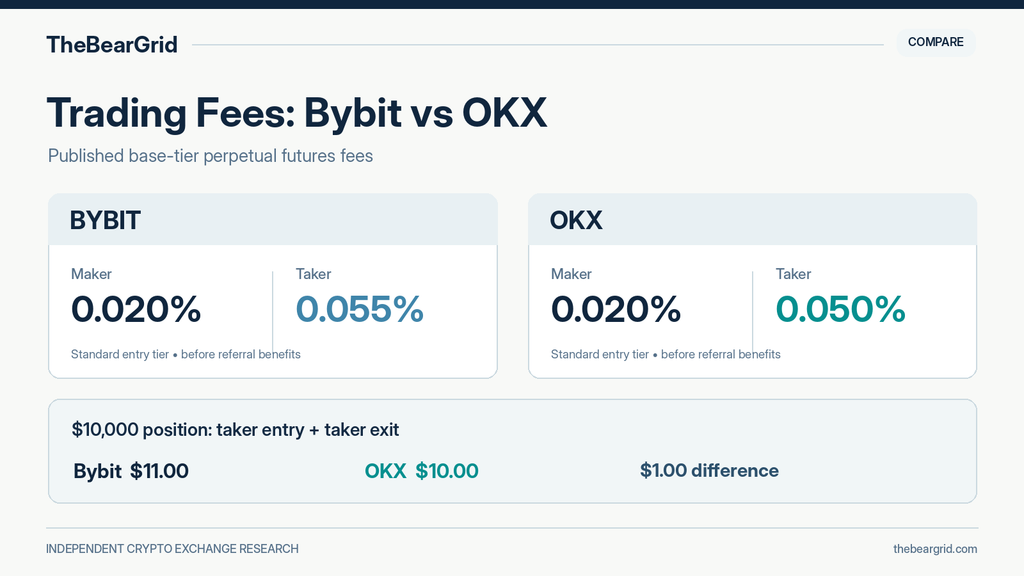
Bybit’s published VIP 0 perpetual futures fees are:
- Maker: 0.020%
- Taker: 0.055%
OKX’s published regular futures fees are:
- Maker: 0.020%
- Taker: 0.050%
A maker order generally adds liquidity to the order book, while a taker order removes existing liquidity.
The difference matters because a trader placing market orders will typically incur taker fees.
Example: Opening and Closing a $10,000 Position
Consider a trader who opens a BTC perpetual position worth $10,000 and later closes it.
Assume the position notional remains $10,000 for both transactions and both orders execute entirely as taker orders.
Trading Fee = Executed Notional × Applicable Fee Rate
| Cost | Bybit | OKX |
|---|---|---|
| Entry taker fee | $5.50 | $5.00 |
| Exit taker fee | $5.50 | $5.00 |
| Total trading fees | $11.00 | $10.00 |
Illustrative example. Excludes funding, slippage, liquidation charges, discounts, rebates, and changes in closing notional.
Under these assumptions, OKX costs $1 less per completed round trip.
For a trader executing the same round trip 100 times, that difference would accumulate to $100 before other expenses.
This does not mean every trader will save that amount.
Actual costs depend on maker-versus-taker execution, order size, VIP tier, contract type, and any applicable discounts or rebates.
If both entry and exit execute as maker orders at the standard rates, the simplified combined fee would be $4 on either platform.
Why the Lowest Fee Is Not Always the Lowest Cost
Trading fees are only one part of execution costs.
A trader should also consider the bid-ask spread and slippage.
For example, saving $1 in trading fees may be insignificant if the exchange delivers several dollars of additional slippage on the same order.
This is particularly important when trading large positions or contracts with limited order-book depth.
Without matched, time-stamped order-book measurements, it would be inappropriate to declare either Bybit or OKX the more liquid exchange across all perpetual markets.
The more useful approach is to compare execution conditions for the exact contract and order size.
For background, see Why Crypto Exchange Trading Volume Doesn’t Equal Liquidity.
3. Funding Rates: The Cost That Changes Over Time
Perpetual futures have no fixed expiration date.
To help keep perpetual prices aligned with underlying reference markets, exchanges use funding payments between long and short position holders.
When the funding rate is positive, longs generally pay shorts. When it is negative, shorts generally pay longs.
Both Bybit and OKX use this mechanism, but funding rates and settlement intervals depend on the contract and market conditions.
Bybit Funding
Bybit states that different trading pairs may have different funding intervals and rate limits.
An eight-hour settlement cycle is common for some contracts, but other intervals may apply.
Bybit also documents circumstances in which settlement frequency can change under specified market conditions.
OKX Funding
OKX likewise uses contract-specific funding settlements.
Its documentation recognizes settlement intervals of eight, four, two, or one hour, depending on the contract.
This makes comparing a single displayed funding percentage potentially misleading.
Compare Funding Over the Same Holding Period
Suppose two contracts have the following hypothetical rates:
- Exchange A: +0.010% every eight hours.
- Exchange B: +0.004% every four hours.
For a trader holding a long position through a full 24-hour period, assuming constant rates and position values:
Exchange A: 3 settlements × 0.010% = 0.030%
Exchange B: 6 settlements × 0.004% = 0.024%
The second exchange has a lower assumed total funding cost over the same period, even though settlement occurs more frequently.
These values are purely illustrative; they are not observed Bybit or OKX funding rates.
Real funding rates can change at each settlement, and the direction of payments can reverse.
The correct comparison is therefore based on the same contract, same observation time, and equivalent holding period.
Traders planning to hold leveraged positions for hours or days should examine funding costs rather than choosing an exchange solely on entry and exit fees.
For more detail, see What Is a Funding Rate in Crypto Perpetual Futures?.
4. Margin Modes and Collateral Management
Margin mode determines how collateral supports leveraged positions and how losses affect the account.
Both Bybit and OKX offer ways to separate position collateral or share eligible collateral across multiple positions.
The practical difference lies in their account structure and risk calculations.
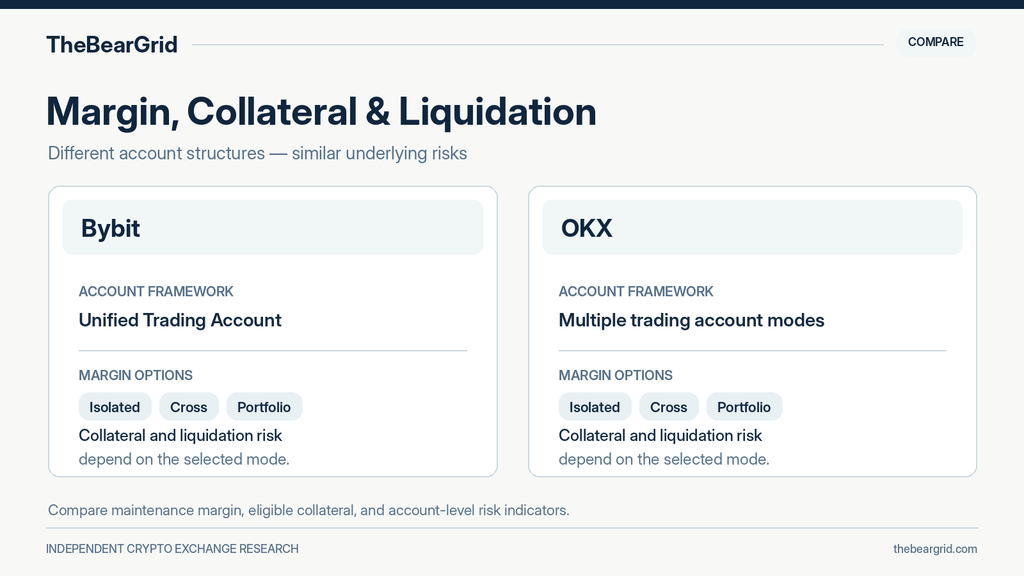
Bybit: Unified Trading Account
Bybit’s Unified Trading Account combines supported spot, futures, and options activity within a shared account framework.
The platform supports three main margin modes:
- Isolated Margin
- Cross Margin
- Portfolio Margin
In Isolated Margin, individual derivatives positions have their own allocated margin.
In Cross Margin, eligible account collateral can support multiple positions, and the account’s overall risk indicators become important.
Portfolio Margin uses a broader risk-based approach for qualifying accounts and positions.
The benefit of unified collateral is flexibility.
The corresponding risk is that a loss in one derivatives position may affect assets supporting other activities within the same eligible account.
OKX: Account Modes and Risk Offsetting
OKX uses multiple trading account modes.
In single-currency margin arrangements, eligible positions sharing the same settlement currency may offset gains and losses within the relevant collateral pool.
Multi-currency margin arrangements can support a broader set of eligible collateral assets and instruments.
Portfolio Margin applies additional portfolio-level risk calculations for qualifying users.
The important point is that selecting Cross Margin does not mean every asset held on the platform is necessarily available to support every position.
Collateral eligibility depends on the selected account mode and relevant product rules.
Which Structure Is Easier to Manage?
For a trader holding one isolated BTC perpetual position, the differences may be relatively limited.
For someone running several futures positions with different settlement currencies, the account framework becomes much more important.
The most useful questions are:
- Which assets can support the position?
- Can losses in another position reduce the available margin?
- Is liquidation evaluated mainly at the position or account level?
- Can margin be added automatically?
- What happens to other positions during an account-level risk event?
The answer depends on the actual configuration rather than the exchange name alone.
See Cross Margin vs Isolated Margin: Key Differences for a worked example of how shared and allocated collateral affect risk.
5. Liquidation: Why the Account Mode Matters
Leverage magnifies the effect of adverse price movements relative to committed collateral.
Both exchanges use mark-price-based risk mechanisms, but liquidation procedures depend on position size, maintenance margin, and the selected account mode.
Bybit Liquidation
Bybit’s documentation distinguishes between isolated and account-level liquidation processes.
In Isolated Margin, liquidation is triggered when the mark price reaches the position’s liquidation level.
Under Cross or Portfolio Margin, the account’s overall margin condition is central to the liquidation process.
Bybit also documents procedures that may reduce positions before full liquidation.
OKX Liquidation
OKX uses maintenance margin requirements and mark-price-based risk controls.
Its documentation describes tiered maintenance margin requirements, meaning larger positions may face different risk thresholds.
The exchange may reduce or liquidate positions when the relevant margin conditions are no longer satisfied.
The Practical Difference
It is not meaningful to say that one exchange is categorically safer from liquidation without comparing equivalent positions.
Consider two BTC perpetual positions with identical notional exposure.
If they use different collateral balances, account modes, or maintenance margin tiers, their liquidation conditions may differ even when the leverage setting looks similar.
A fair comparison must control for those variables.
Traders should check the platform’s displayed liquidation estimate, maintenance margin requirements, and account-level risk indicators before opening a position.
For a deeper explanation, read How Crypto Futures Liquidation Works.
6. Which Exchange Is Better for Perpetual Futures?
The decision is better framed around trading requirements than a single overall winner.
When Bybit May Be Worth Evaluating
Bybit may appeal to traders who want to use its Unified Trading Account framework and manage supported spot and derivatives products within one account.
Its published documentation provides detailed explanations of account collateral, liquidation, and margin modes.
For a trader already using Bybit’s account structure, the higher standard taker fee may or may not outweigh other operational preferences.
However, the trader should examine the collateral exposure created by Cross or Portfolio Margin.
Read our Bybit Exchange Profile for a broader review of its derivatives products and trading risks.
When OKX May Be Worth Evaluating
OKX deserves consideration from traders who prioritize lower published standard taker fees.
Its different trading-account modes also provide multiple approaches to collateral and risk management.
For a frequent market-order trader, the 0.005 percentage-point difference in published taker fees can become meaningful over many transactions.
But the cost advantage should be assessed after funding, slippage, account-specific rates, and any valid incentives.
Read our OKX Exchange Profile for further information on its products and trading conditions.
A Practical Decision Checklist
| Trading Priority | What to Compare |
|---|---|
| Frequent market orders | Actual taker fee after applicable benefits |
| Mostly maker orders | Maker fee and realized fill quality |
| Holding positions overnight | Funding costs over matching intervals |
| Multiple derivatives positions | Account mode and collateral-sharing rules |
| Larger order sizes | Order-book depth and slippage |
| Managing liquidation risk | Maintenance margin and account risk indicators |
This framework avoids declaring a universal winner based on incomplete information.
Partner Trading Fee Benefits
TheBearGrid maintains affiliate partnerships with both Bybit and OKX.
Under TheBearGrid’s current partner arrangements, eligible referred users may receive different types of trading-fee benefits.
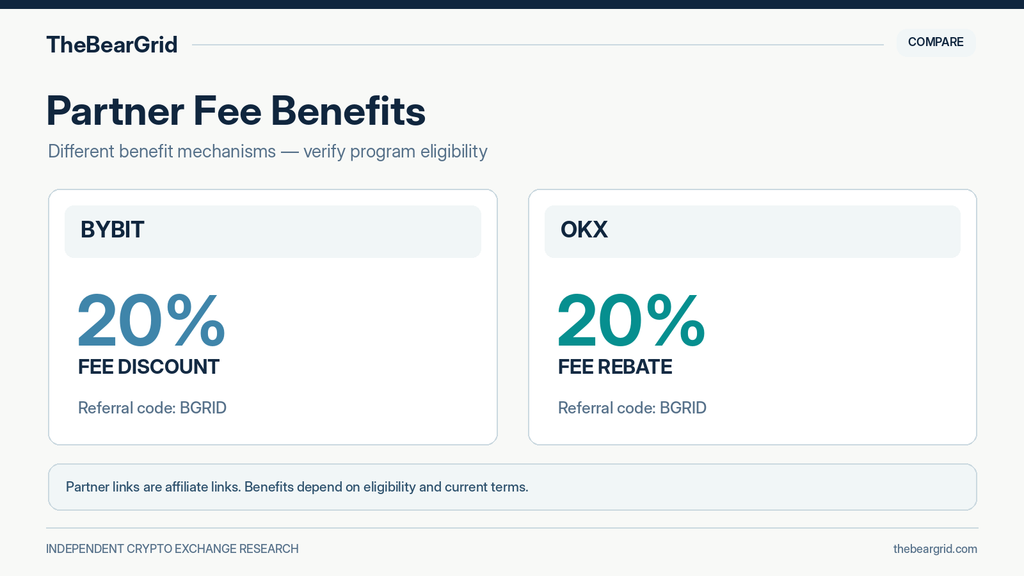
Bybit — 20% Trading Fee Discount
Bybit’s partner arrangement offers eligible referred users a reported 20% trading-fee discount.
A discount reduces an applicable trading fee rather than providing a separate cashback payment.
- Partner referral code: BGRID
- Partner benefit: 20% fee discount, subject to program conditions
Visit Bybit via TheBearGrid Partner Link
OKX — 20% Trading Fee Rebate
OKX’s partner arrangement offers eligible referred users a reported 20% trading-fee rebate.
Unlike an upfront fee discount, a rebate generally returns an eligible portion of trading fees according to the applicable settlement rules.
- Partner referral code: BGRID
- Partner benefit: 20% fee rebate, subject to program conditions
Visit OKX via TheBearGrid Partner Link
Before registering: These partner benefits are based on TheBearGrid’s stated arrangements with the exchanges. Their exact product coverage, eligibility, application method, settlement timing, and compatibility with VIP or promotional rates must be confirmed under the current terms.
The standard trading fees compared earlier in this article do not include these benefits.
Affiliate disclosure: Both links above are affiliate links. TheBearGrid may receive commissions from qualifying trading activity. This does not increase the reported standard exchange fees or establish that either platform is preferable for a particular trader.
Conclusion
Bybit and OKX offer broadly comparable perpetual futures capabilities, but their trading costs and account structures differ.
At the published standard entry tier, OKX has the lower taker fee, while both exchanges list the same maker fee.
Bybit’s Unified Trading Account and OKX’s multiple account modes create different operational considerations for traders managing collateral and leveraged positions.
Funding costs and liquidation rules can matter more than a small difference in transaction fees.
Partner fee discounts and rebates may reduce trading expenses for qualifying users, but they should be considered separately from execution quality and risk management.
The better exchange is the one whose verified costs, account structure, and risk-management features match the trader’s actual strategy.
A trading platform should be evaluated on its operating conditions—not merely on its published fee table or promotional incentives.
Related Research
- Bybit Exchange Profile: Derivatives, Fees, and Risks
- OKX Exchange Profile: Derivatives, Fees, and Risks
- Cross Margin vs Isolated Margin: Key Differences
- Why Crypto Exchange Trading Volume Doesn’t Equal Liquidity
- What Is a Funding Rate in Crypto Perpetual Futures?
Sources and Methodology
- Bybit — Trading Fee Structure. Standard derivatives fee tiers and account-specific variations.
- OKX — Updates to Global Fee Framework. Published maker and taker fee structure.
- OKX — Trading Fee Rules FAQ. Fee calculation and account-specific rates.
- Bybit — Unified Trading Account. Margin modes and shared collateral.
- Bybit — UTA Liquidation Rules. Risk calculations and liquidation.
- OKX — Differences in Trading Account Modes. Account configuration and collateral treatment.
- Bybit — Funding Fee Calculation. Funding intervals and payments.
- OKX — Perpetual Funding Fee Mechanism. Settlement intervals and funding calculations.
Research date: November 13, 2026.
Methodology: This article compares published exchange documentation for standard crypto perpetual futures. Fee examples use equal illustrative notional amounts. No independently captured order-book data, simultaneous funding-rate observations, or firsthand order-execution tests were used. Consequently, the article makes no comparative claim about real-time liquidity, slippage, uptime, or execution performance.
Affiliate note: TheBearGrid may earn commissions from eligible activity through its disclosed partner relationships. The reported 20% discount and rebate are based on partner-provided information, and their detailed eligibility conditions have not been independently verified for this article.
Disclaimer: This article is for informational purposes only and does not constitute investment or financial advice. Cryptocurrency derivatives involve substantial risks, including leverage, funding costs, slippage, liquidation, and counterparty exposure.
Availability note: Available products and account features may be restricted depending on the user’s jurisdiction.