Two traders open the same Bitcoin perpetual futures position with the same leverage.
Both enter at the same price. Both experience the same market movement. Yet one position approaches liquidation while the other still has additional collateral available.
The difference may come from the margin mode.
Cross Margin and Isolated Margin determine how collateral supports a leveraged position and how trading losses can affect the rest of an account.
They do not change the underlying price movement or automatically make a trade more profitable. Instead, they change how risk is distributed.
Understanding that distinction is essential before trading perpetual futures on exchanges such as Binance, Bybit, and OKX.
Table of Contents
1. Cross Margin vs Isolated Margin: The Basic Difference
Margin is the collateral required to open and maintain a leveraged derivatives position.
In perpetual futures, traders can control a position larger than the collateral initially committed.
For example, a $2,000 position opened with 5× leverage requires approximately $400 in initial margin, excluding applicable fees and other requirements.
The margin mode determines how that position is supported after it opens.
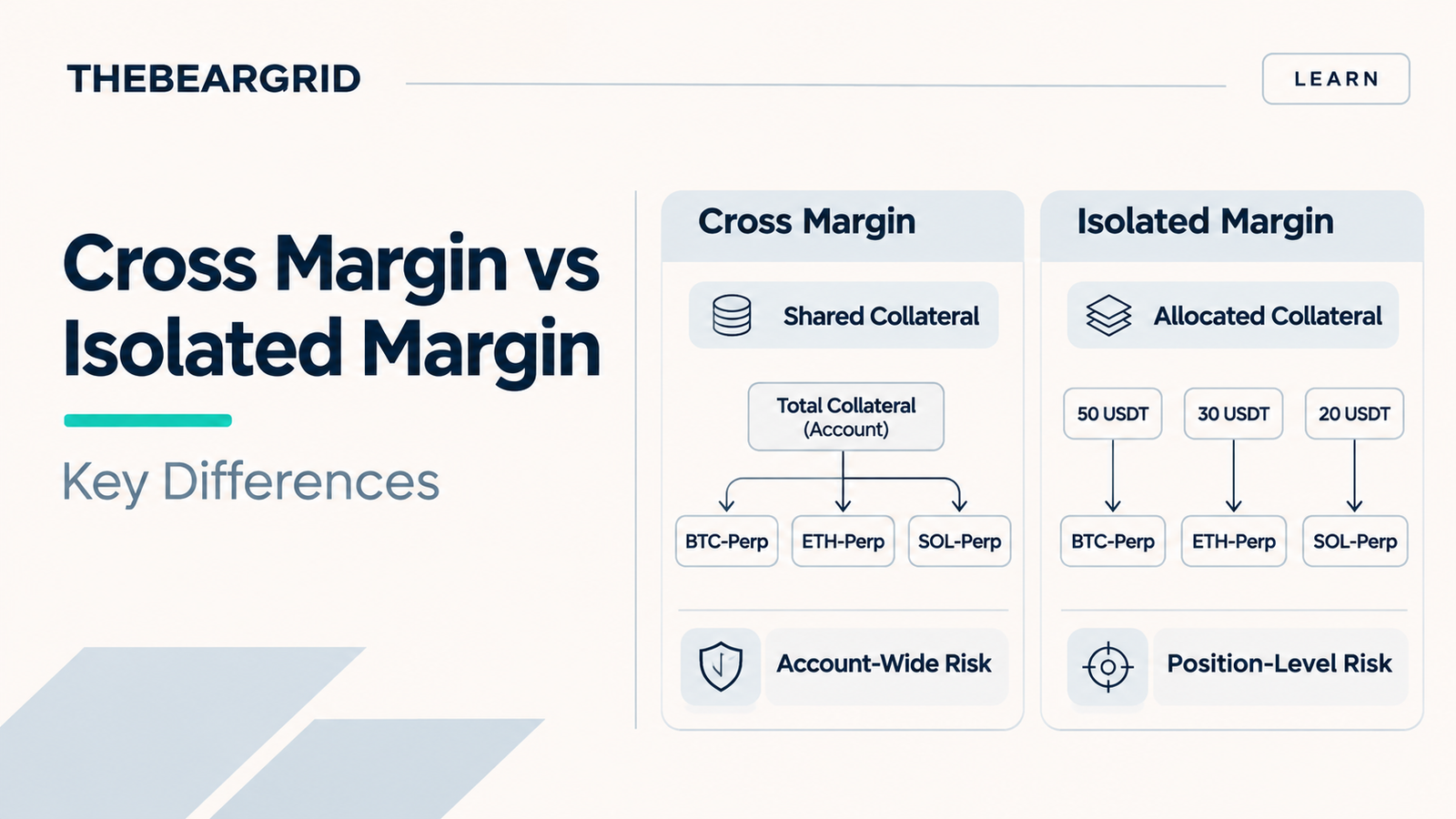
Cross Margin: Shared Collateral
Cross Margin allows eligible collateral in a trading account or collateral pool to support multiple positions.
If one position moves against the trader, additional available collateral may help maintain it.
Unrealized gains and losses from different positions may also contribute to the account’s overall risk calculation, depending on the exchange and account mode.
This provides flexibility. However, a losing position can consume collateral that might otherwise support other trades.
Cross Margin can reduce the risk of an individual position being liquidated early, but it can expose more of the eligible trading-account balance to losses.
Isolated Margin: Allocated Collateral
Isolated Margin assigns a specific amount of collateral to a position.
Losses and liquidation risk are generally evaluated against that allocated margin rather than automatically drawing from the wider account balance.
This makes it easier to separate the risk associated with individual trades.
The trade-off is that a position with limited collateral may approach liquidation sooner than the same position supported by a larger cross-margin balance.
Isolated Margin can also support manual margin additions, and some exchanges offer automatic replenishment features.
That means the amount initially allocated is not always the final amount that can be used.
Side-by-Side Comparison
| Feature | Cross Margin | Isolated Margin |
|---|---|---|
| Collateral | Shared within an eligible account or pool | Allocated to a position |
| Risk exposure | Multiple positions may affect shared equity | Position risk generally separated |
| Additional margin | Available eligible balance can support positions | Usually requires a margin addition |
| Liquidation assessment | May depend on overall account risk | Primarily position-level risk |
| Main advantage | Capital flexibility | Clearer risk separation |
| Main drawback | Losses can affect more collateral | Less buffer against adverse moves |
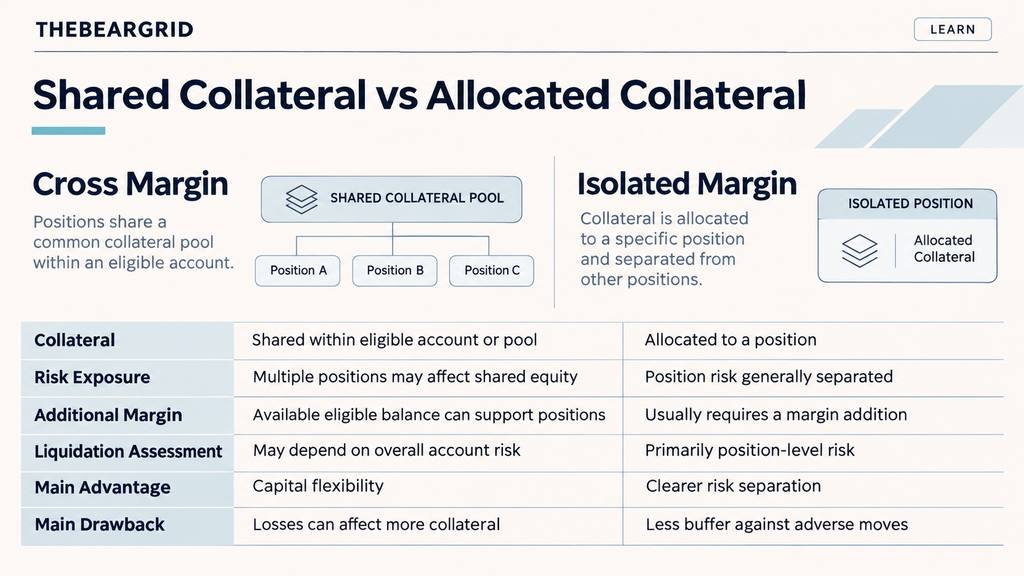
Exact rules vary by exchange, account configuration, and contract type.
2. A Practical Example: The Same Trade Under Both Modes
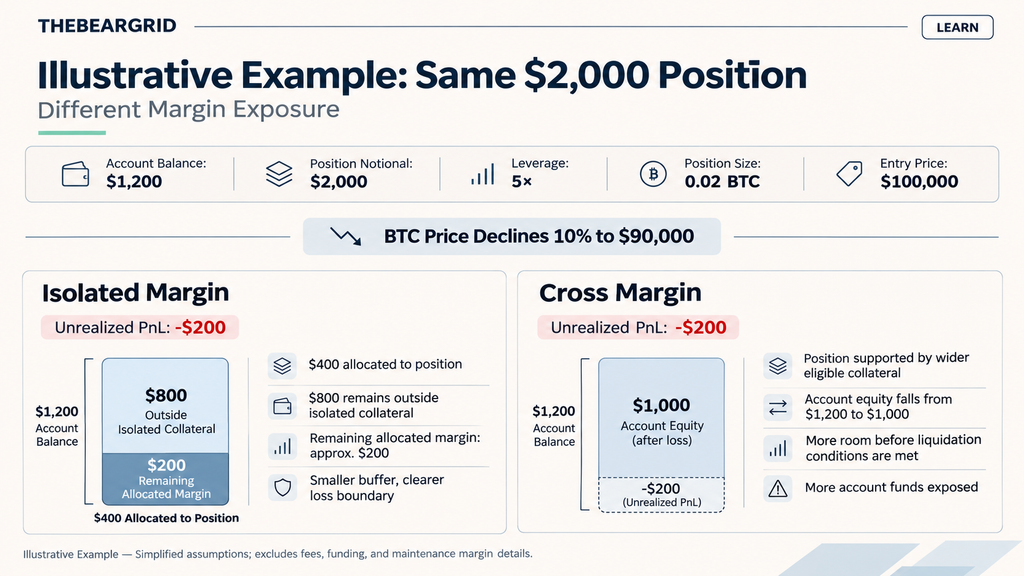
Consider a trader with $1,200 USDT in a derivatives trading account.
The trader opens a BTCUSDT perpetual futures long position.
| Item | Value |
|---|---|
| Trading Account Balance | $1,200 |
| BTC Entry Price | $100,000 |
| Position Size | 0.02 BTC |
| Position Notional | $2,000 |
| Leverage | 5× |
| Initial Margin Requirement | Approximately $400 |
The trader has $800 remaining after satisfying the simplified initial margin requirement.
For this illustration, assume there are no other positions or orders. Ignore fees, funding payments, maintenance margin requirements, and collateral adjustments until the liquidation discussion.
Scenario A: Using Isolated Margin
The trader allocates $400 to the BTC position.
The remaining $800 stays outside the position’s isolated collateral.
Now suppose Bitcoin falls from $100,000 to $90,000.
The long position experiences a 10% adverse price movement.
The simplified unrealized PnL is:
Unrealized PnL = Position Size × (Current Price − Entry Price)
= 0.02 BTC × ($90,000 − $100,000)
= −$200
The isolated position has absorbed a $200 unrealized loss.
Its simplified remaining allocated margin is approximately $200.
The other $800 is not automatically available to support that position under the assumed isolated setup.
If the loss continues, the position can reach its maintenance margin threshold and face liquidation.
Scenario B: Using Cross Margin
Now assume the trader opens the same $2,000 position using Cross Margin.
The initial margin requirement is still approximately $400.
However, the wider eligible collateral balance can support the trade.
After the same 10% Bitcoin decline, the position again has a $200 unrealized loss.
The simplified trading-account equity falls from $1,200 to $1,000.
The unrealized PnL is identical to the isolated-margin example.
The difference is the collateral available to absorb further losses.
Under Cross Margin, the position may have more room before account-level liquidation conditions are met.
But that additional buffer comes from funds elsewhere in the eligible account.
If the position continues losing, more of the $1,200 balance may become exposed.
What Happens if Bitcoin Keeps Falling?
In an isolated position with no added margin, the trader’s loss-absorbing buffer is limited to the allocated collateral, subject to the exchange’s liquidation mechanics.
Under Cross Margin, more eligible account equity can support the position.
Consequently, Cross Margin may allow the losing trade to remain open longer, but at the cost of putting additional funds at risk.
Neither mode guarantees that the trader can hold the position through a particular percentage decline.
Liquidation usually occurs before a simplified margin balance reaches zero, because exchanges require maintenance margin and may account for closing fees, funding, and other risk parameters.
The example explains collateral allocation, not an exact liquidation-price calculation.
3. Why Cross Margin Can Create Account-Wide Risk
The shared-collateral structure becomes more important when a trader holds several positions.
Imagine a trader has three open perpetual futures positions:
- BTC long position with an unrealized loss of $300.
- ETH long position with an unrealized loss of $200.
- SOL short position with an unrealized gain of $100.
The combined unrealized PnL is approximately −$400.
Under a Cross Margin arrangement that includes all three contracts in the same collateral pool, these results contribute to the pool’s risk assessment.
Profitable positions can help offset losses, but simultaneous losses can rapidly weaken the shared margin balance.
Correlated Positions Can Amplify the Problem
Crypto derivatives positions are often exposed to common market movements.
A trader holding leveraged longs in BTC, ETH, and SOL may appear diversified across three assets.
But during a broad market decline, all three positions can lose value together.
Cross Margin allows the losses to interact through shared collateral.
This can create a situation in which several losing positions weaken the account simultaneously, potentially leading to forced position reductions or liquidation.
The important question is therefore not simply how many positions the trader holds.
It is how much of the account is exposed to the same underlying market risk.
Cross Margin Does Not Mean Unlimited Collateral Sharing
Collateral sharing depends on the exchange’s account structure.
Some platforms group positions by settlement asset. Others support broader multi-asset or unified collateral arrangements.
Funds held in separate accounts or excluded from the eligible collateral pool may not be available to support cross-margin positions.
Traders should verify exactly which assets and balances are included rather than assuming every asset held on an exchange is at risk.
4. Does Isolated Margin Always Limit Losses to the Initial Margin?
Not necessarily.
Isolated Margin is designed to separate position collateral, but its protective effect depends on how the account is configured.
The most important exception is automatic margin replenishment.
Automatic Margin Additions
Bybit, for example, provides an Auto-Margin Replenishment feature for supported isolated-margin derivatives contracts.
When enabled, the feature can transfer available funds from the Unified Trading Account into an isolated position as liquidation risk increases.
Adding margin can move the liquidation price farther from the mark price.
However, it also increases the amount of account funds committed to that position.
Suppose a trader initially allocates $400.
If an automatic replenishment feature subsequently adds another $200, the amount committed to the position becomes $600.
The position is still classified as Isolated Margin, but the initial $400 is no longer the complete amount exposed.
A trader who selected Isolated Margin specifically to limit a trade’s loss budget should therefore check whether automatic margin additions are enabled.
Manual Margin Additions Have the Same Trade-Off
Manually adding collateral can help a position survive a larger adverse movement.
But it also increases the funds exposed to that trade.
Additional margin is not free protection. It is a decision to commit more capital.
Isolated Margin Does Not Replace Risk Management
An isolated position can still suffer liquidation.
It can also incur trading fees, funding payments, and losses from adverse execution.
The margin allocation controls how collateral is organized; it does not prevent the underlying market from moving against the trader.
For a detailed explanation, see How Crypto Futures Liquidation Works.
5. How Binance, Bybit, and OKX Implement Margin Modes
The principles of Cross and Isolated Margin are broadly similar across centralized derivatives exchanges.
However, the way traders configure them can differ significantly.
| Exchange | Key Implementation Detail |
|---|---|
| Binance Futures | Margin mode can be selected for an individual contract, subject to account and position restrictions |
| Bybit UTA | Selected margin mode applies at the Unified Trading Account level |
| OKX | Margin sharing depends on account mode, settlement currency, and collateral configuration |
Binance: Contract-Level Selection
Binance Futures documentation describes switching between Cross and Isolated Margin for a selected contract.
The exchange also explains that the eligible shared collateral depends on the relevant asset and futures account configuration.
A trader should therefore distinguish between USDT-margined, USDC-margined, coin-margined, and multi-asset arrangements.
The practical implication is that Cross Margin on one contract does not necessarily mean that every balance across all Binance accounts is shared.
See our Binance Exchange Profile for broader information on derivatives products, trading costs, and risks.
Bybit: Unified Trading Account Rules
Bybit’s Unified Trading Account supports Isolated Margin, Cross Margin, and Portfolio Margin.
According to its documentation, margin-mode selection applies to the Unified Trading Account rather than being independently selected for every trading pair.
In Isolated Margin, individual derivatives positions have their own allocated margin and position-level liquidation conditions.
In Cross Margin, risk management uses account-level maintenance margin calculations.
This makes it especially important to review the entire account’s risk indicators rather than relying solely on an individual position’s estimated liquidation price.
Bybit also supports automatic margin replenishment for eligible isolated-margin contracts.
For additional exchange details, see our Bybit Exchange Profile.
OKX: Settlement Assets and Account Modes
OKX distinguishes between Cross and Isolated Margin within its supported trading-account structures.
In its futures-mode documentation, products settled in the same cryptocurrency can share collateral under Cross Margin.
By contrast, isolated positions are managed with separate margin allocations.
More advanced account arrangements can involve different collateral rules.
The relevant risk is therefore determined not only by the margin mode selected, but also by the account and settlement configuration.
See our OKX Exchange Profile for further information on its derivatives products and operating conditions.
Exchange features, eligibility, and margin rules may differ by jurisdiction, product, and account type. The descriptions above summarize official documentation rather than independently tested trading-account behavior.
6. Which Margin Mode Makes More Sense?
There is no universally superior margin mode.
The choice depends on the purpose of the position and the amount of account capital the trader is willing to expose.
When Isolated Margin May Be More Suitable
Isolated Margin can be useful when a trader wants a defined collateral allocation for a speculative position.
For example, someone experimenting with a volatile altcoin perpetual contract may prefer to keep that trade separate from other positions.
Its main advantage is not necessarily a better liquidation price.
It is the ability to create a clearer boundary around the capital committed to a trade, provided additional margin is not automatically supplied.
When Cross Margin May Be More Suitable
Cross Margin can be useful for traders managing multiple related positions or strategies that benefit from shared collateral.
A hedged portfolio may use gains and losses from different positions to support the overall account.
However, this approach requires careful monitoring of total equity, maintenance margin, and correlated exposures.
The structure can improve capital flexibility while also making the consequences of a portfolio-wide loss more significant.
Three Questions to Ask Before Choosing
1. How much capital should this trade be allowed to consume?
If the objective is to keep the potential collateral loss associated with a position separate from the rest of the account, Isolated Margin may provide a clearer structure.
2. Are other positions relying on the same collateral?
Cross Margin can create interactions between positions that are not obvious when reviewing each trade individually.
3. What happens if the position needs additional margin?
The trader should understand whether additional collateral will be added automatically, manually, or through shared account equity.
The answers matter more than choosing a mode because it appears safer or more convenient.
7. Margin Mode Is Not the Same as Leverage
Margin mode and leverage are related, but they control different aspects of a futures position.
Leverage determines the relationship between position notional and the required initial collateral.
Margin mode determines how collateral is allocated and shared when supporting that position.
A $2,000 position opened with 5× leverage has the same price sensitivity under both modes if the position size is identical.
A 1% adverse move in the underlying position produces approximately a $20 unrealized loss, excluding fees and funding, regardless of the margin mode.
What changes is how that loss affects the available collateral and the conditions under which liquidation may occur.
This distinction also explains why a higher leverage setting does not automatically increase profit or loss if the trader keeps the exact same position size.
For the same notional exposure, the underlying price movement creates the same PnL.
Leverage and margin mode change how much collateral is required or exposed, not the fundamental price movement of the contract.
For further background, see What Are Perpetual Futures?.
Conclusion
Cross Margin and Isolated Margin are two approaches to managing collateral in leveraged crypto futures trading.
Cross Margin allows eligible collateral to support multiple positions, improving flexibility but potentially exposing a larger share of account equity to losses.
Isolated Margin separates the collateral assigned to a position, making risk allocation easier to manage but potentially leaving the position with a smaller liquidation buffer.
Neither approach removes the risk of leverage.
The choice should begin with a practical question:
How much of the trading account should be exposed if this position moves against the trader?
Understanding that answer—and the exchange-specific rules governing collateral sharing, maintenance margin, and automatic additions—is more important than treating either mode as inherently safer.
Related Research
- How Crypto Futures Liquidation Works — Maintenance margin, mark price, and liquidation.
- Mark Price vs Index Price vs Last Traded Price — How exchanges evaluate positions and liquidation triggers.
- What Are Perpetual Futures? — Leverage, funding, and perpetual-contract basics.
- Binance Exchange Profile: Derivatives, Fees, and Risks — Binance futures products, trading conditions, and risk considerations.
Sources
- Binance Academy — What Are Isolated Margin and Cross Margin in Crypto Trading?
- Binance Futures — How to Switch Between Cross and Isolated Margin
- Binance — Single-Asset and Multi-Assets Modes
- Bybit — Differences Between Margin Modes Under the Unified Trading Account
- Bybit — Auto-Margin Replenishment
- Bybit — Liquidation Process Under the Unified Trading Account
- OKX — Futures Mode: Cross Margin Trading
- OKX — Isolated Margin Mode
Source review: November 10, 2026. Exchange-specific features and eligibility are subject to change. All numerical trading examples are illustrative and do not use observed market data.
Editorial note: This article compares collateral and risk-management mechanisms. It does not recommend a particular exchange, margin mode, or leverage setting.
Disclaimer: This article is for educational purposes only and does not constitute financial or investment advice. Trading cryptocurrency derivatives involves significant risks, including leverage, liquidation, funding costs, slippage, and exchange-related risks.