A Bitcoin perpetual futures chart shows BTC trading above your entry price, yet your position displays an unrealized loss.
Or the opposite happens: your position is liquidated even though the price on the candlestick chart never appears to reach your liquidation level.
These situations can occur because a futures exchange uses several different price references for the same contract.
The three most important are Index Price, Mark Price, and Last Traded Price.
They are closely related, but they serve different purposes. One represents the broader underlying market, another is used to evaluate positions and liquidation risk, and the third records the latest executed trade.
Understanding which price controls each function is essential for anyone trading crypto perpetual futures.
Table of Contents
1. Three Prices, Three Different Purposes
On a perpetual futures trading screen, the three prices may appear almost identical during quiet market conditions.
However, they can diverge when trading activity becomes volatile or the futures contract temporarily trades at a premium or discount to the underlying market.
| Price Type | What It Represents | Main Purpose |
|---|---|---|
| Index Price | Reference value derived from underlying spot markets | Underlying market benchmark |
| Mark Price | Exchange-calculated valuation of the futures contract | Unrealized PnL and liquidation risk |
| Last Traded Price | Price of the latest executed futures trade | Trading activity and price charts |
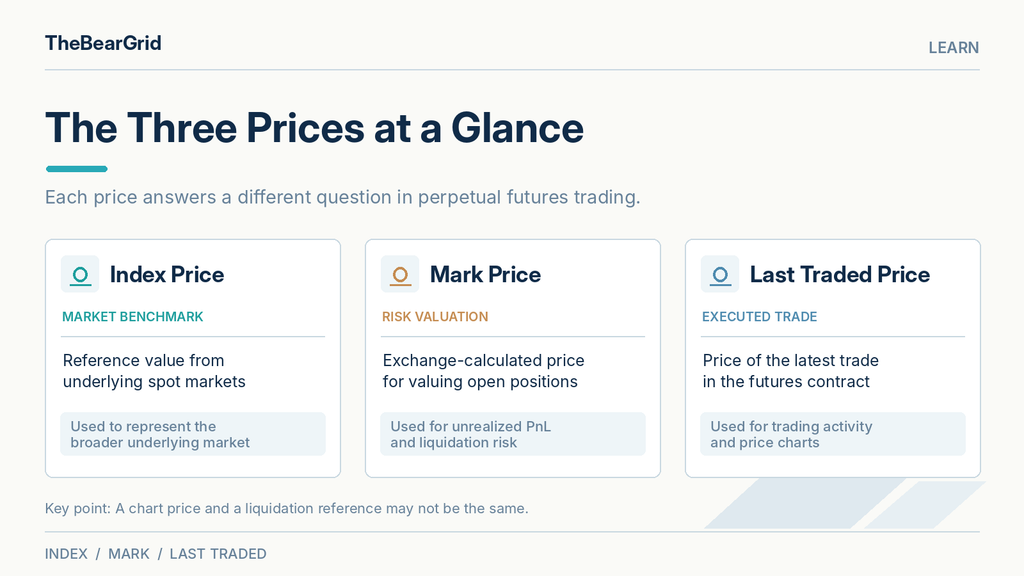
The simplest way to distinguish them is to ask three questions.
Index Price: Where is the underlying asset trading across the reference markets?
Mark Price: How does the exchange currently value this futures position for risk purposes?
Last Traded Price: At what price did the most recent transaction occur on this exchange?
These questions are related, but their answers do not have to match.
A trader who monitors only the last traded price may misunderstand the unrealized PnL displayed on an open position or the risk of liquidation.
2. Index Price: The Broader Market Reference
The index price is designed to represent the underlying asset’s value using prices from multiple reference markets.
For a BTC/USDT perpetual futures contract, an exchange may calculate an index using selected Bitcoin spot markets.
Rather than relying on a single venue’s latest trade, the exchange combines several market prices according to its published methodology.
The calculation may involve:
- Prices from selected spot exchanges.
- Different weights for individual price sources.
- Adjustments or exclusions for abnormal prices.
- Procedures for missing or delayed market data.
The goal is to create a reference that is less dependent on unusual activity at any one trading venue.
Why Not Use a Single Spot Exchange?
Imagine Bitcoin is trading near $100,000 across several major spot exchanges.
A temporary liquidity shortage causes a trade on one venue to execute at $99,500.
If the futures exchange relied only on that venue, its reference price could move sharply even though the broader market remained relatively stable.
A multi-source index is intended to reduce the influence of such isolated events.
However, an index is not a perfect measure of a universal market price. Its accuracy depends on the selected constituents, weighting rules, data quality, and fallback procedures.
Two exchanges can therefore publish slightly different Bitcoin index prices at the same moment.
How the Index Connects to Perpetual Futures
Perpetual futures do not expire on a scheduled date, so exchanges use mechanisms such as funding payments to encourage their prices to remain reasonably aligned with the underlying market.
The index price plays an important role in this process.
When perpetual futures trade above or below their underlying reference market, that difference contributes to the premium measures used in funding calculations.
For a more detailed explanation, see What Is a Funding Rate in Crypto Perpetual Futures?.
3. Mark Price: The Price Used to Evaluate Risk
The mark price is a calculated reference value used by derivatives exchanges to assess open positions.
For major centralized perpetual futures venues, it commonly incorporates the underlying index price together with information about the futures contract itself.
Its primary purpose is to reduce the influence of isolated price spikes on unrealized PnL and liquidation calculations.
A mark price is not necessarily the latest traded price, and it is not an order that a trader can execute against.
Why Exchanges Use Mark Price
Suppose a large market sell order briefly pushes the last traded price of a BTC perpetual contract far below the broader market.
If liquidations relied directly on that isolated transaction, positions could be forced to close because of a short-lived price dislocation.
A mark-price mechanism is designed to moderate that problem by using additional market information.
However, it does not eliminate liquidation risk.
If the broader market genuinely moves against a position, the mark price can move with it and trigger the exchange’s risk controls.
Example: Why Your PnL May Disagree With the Chart
Consider a hypothetical USDT-margined Bitcoin perpetual position.
A trader opens a long position with these details:
| Item | Value |
|---|---|
| Entry Price | $100,000 |
| Position Size | 0.10 BTC |
| Last Traded Price | $100,100 |
| Mark Price | $99,800 |
The latest trade is $100 above the entry price.
Looking only at the last traded price, the trader might expect a small unrealized profit.
But if the exchange values the position using the mark price, the simplified unrealized PnL is:
Unrealized PnL = (Mark Price − Entry Price) × Position Size
= ($99,800 − $100,000) × 0.10 = −$20
The position therefore shows an unrealized loss of approximately $20, excluding funding and fees.
This does not mean the trader has already realized a $20 loss.
The final trading result depends on the actual closing execution, applicable fees, funding payments, and other adjustments.
The example demonstrates why a position’s displayed PnL can differ from what the default price chart appears to suggest.
4. Last Traded Price: What Actually Happened in the Market
The last traded price is the price at which the most recent transaction occurred in a specific futures contract.
For example, if the most recent BTCUSDT perpetual trade on an exchange executed at $100,100, that becomes the last traded price until another trade occurs.
This is typically the reference used to construct the exchange’s default candlestick chart.
Unlike the index price or mark price, it represents an actual completed transaction.
But this introduces an important limitation.
The Last Price Is Not a Guaranteed Execution Price
A last traded price tells traders where a transaction occurred, not where their next order will necessarily execute.
A market buy order generally interacts with available sell orders in the order book.
A market sell order interacts with available buy orders.
If liquidity is limited or the order is large, execution may occur across multiple price levels.
As a result, the average execution price can differ from the most recent trade.
This difference is commonly described as slippage.
For example, a last price of $100,000 does not guarantee that a trader can immediately sell a large position at $100,000.
The available order-book depth matters.
This is why trading activity, executable liquidity, and mark-price valuation should be examined separately.
For additional context, see Why Crypto Exchange Trading Volume Doesn’t Equal Liquidity.
5. When the Three Prices Diverge
The distinction becomes particularly important during volatile markets.
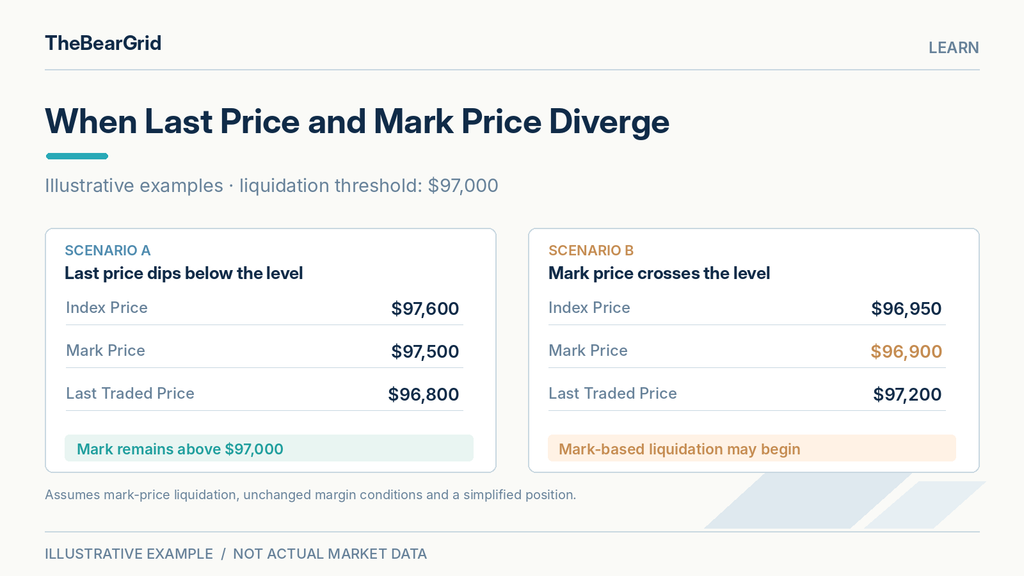
Consider a hypothetical long position with an estimated liquidation price of $97,000.
Assume the exchange’s liquidation mechanism uses the mark price.
Scenario A: Last Price Falls Below the Liquidation Level
| Reference | Price |
|---|---|
| Index Price | $97,600 |
| Mark Price | $97,500 |
| Last Traded Price | $96,800 |
| Estimated Liquidation Price | $97,000 |
In this example, the last traded price briefly falls below the displayed liquidation level.
However, the mark price remains above $97,000.
Assuming all other margin conditions remain satisfied, the isolated last-price movement would not itself trigger liquidation under a mark-price-based mechanism.
The result can confuse traders who compare the lowest candlestick price with the liquidation level shown on their position screen.
Scenario B: Mark Price Crosses the Liquidation Level First
Now consider a different hypothetical snapshot.
| Reference | Price |
|---|---|
| Index Price | $96,950 |
| Mark Price | $96,900 |
| Last Traded Price | $97,200 |
| Estimated Liquidation Price | $97,000 |
Here, the last traded price remains above the displayed liquidation level.
But the mark price has fallen below it.
Under the assumed liquidation rules, the position may enter liquidation even though the default last-price chart does not show a trade below $97,000.
These scenarios illustrate a central principle:
A liquidation threshold must be compared with the price reference used by the exchange’s risk engine—not automatically with the price displayed on the default chart.
Actual liquidation calculations can also depend on maintenance margin, account equity, fees, risk tiers, funding payments, and margin mode.
In cross-margin or portfolio-margin accounts, the exchange may assess overall account risk rather than relying on an isolated position’s displayed liquidation level.
For the complete process, see How Crypto Futures Liquidation Works.
6. Stop-Loss Orders and Liquidations May Use Different Prices
One of the most consequential mistakes in perpetual futures trading is assuming that a stop-loss order and the liquidation engine monitor the same price.
They do not necessarily do so.
Major exchanges such as Binance and Bybit support configurable trigger references for certain conditional orders.
Depending on the product and order interface, traders may be able to choose between:
- Last Traded Price
- Mark Price
- Index Price
The available options and defaults vary by exchange.
Example: A Stop-Loss Triggered by Last Price
Suppose a trader holds a BTC perpetual long position and sets a stop-loss trigger at $98,000 using Last Traded Price.
During a brief sell-off:
- Last Traded Price falls to $97,950.
- Mark Price remains at $98,250.
The stop-loss condition may be met because the selected last-price reference crossed $98,000.
Yet the mark price has not fallen as far.
The trader’s stop could therefore activate without a corresponding mark-price liquidation event.
The reverse is also possible.
A mark-price-triggered stop may activate even when the last-price chart has not reached the same numerical level.
Triggering an Order Is Not the Same as Filling It
This distinction is equally important.
When a stop-market order is triggered, the exchange submits an order for execution. The final fill depends on available liquidity and market conditions.
A stop-limit order may instead place a limit order that remains unfilled if the market moves beyond the specified price.
Consequently, choosing a stop-loss trigger does not guarantee that the position will close before liquidation.
Exchanges also apply product-specific order protections and risk rules that can affect whether a conditional order activates.
Before opening a leveraged position, traders should verify both the trigger reference and the execution method.
7. How Mark Price Calculation Differs Across Exchanges
The purpose of mark pricing is broadly similar across centralized crypto derivatives exchanges, but the calculation methods are not identical.
Official documentation from Binance, Bybit, and OKX illustrates this difference.
| Exchange | Documented Approach | Important Detail |
|---|---|---|
| Binance | Median-based calculation combining multiple price inputs | Uses index, funding-related inputs, order-book basis, and contract price |
| Bybit | Median of three calculated price inputs | Includes index-based values and last traded price |
| OKX | Index price plus a moving-average basis | Uses the difference between futures order-book midpoint and index |
Simplified comparison of documented perpetual-futures pricing methods. Exact formulas, fallback rules, and product coverage can change.
Binance and Bybit use a median-based method for the perpetual contracts described in their documentation.
Rather than allowing a single input to determine the mark price unconditionally, the calculation selects a middle value from several inputs.
OKX describes a different approach, using the index price plus a moving average of the futures contract’s basis.
These differences help explain why mark prices across exchanges may not match exactly, even for contracts referencing the same underlying asset.
What This Means for Traders
A Bitcoin perpetual long position on Binance is not necessarily exposed to the exact same mark-price path as a similar position on Bybit or OKX.
Small differences can emerge because of index constituents, order-book conditions, mark-price formulas, and exchange-specific protection rules.
They become more important when leverage is high and the remaining margin buffer is small.
However, no mark-price formula guarantees protection from liquidation during genuine market-wide price movements.
The relevant calculation should always be checked against the exchange’s current documentation for the specific contract being traded.
A Practical Checklist Before Trading
Rather than trying to memorize every exchange’s pricing formula, traders can focus on five checks.
- Identify the chart price. Determine whether the default chart displays last traded price or another reference.
- Monitor mark price. Compare it with the estimated liquidation level and account risk indicators.
- Check the index. Observe whether the futures contract is trading at a significant premium or discount to its underlying reference market.
- Confirm stop-loss settings. Identify the selected trigger reference and whether the resulting order is market or limit.
- Review exchange-specific rules. Check relevant mark-price methodology, risk tiers, and order protections before using substantial leverage.
These checks do not eliminate trading risk, but they help prevent mistakes caused by confusing different price references.
Conclusion
Index Price, Mark Price, and Last Traded Price describe different aspects of the same perpetual futures market.
The index price provides a reference to the underlying market.
The mark price supports position valuation and liquidation-related risk calculations.
The last traded price records actual trading activity on a particular exchange.
Their differences explain why a chart can appear inconsistent with unrealized PnL, why a liquidation can occur without a matching last-price candle, and why stop-loss orders do not always behave as traders expect.
For active derivatives traders, the objective is not to identify one universally correct price.
It is to understand which price controls each trading function and how that price is calculated.
A futures chart shows what has traded. A position screen shows how the exchange evaluates risk. Confusing the two can become expensive when leverage is involved.
Related Research
- How Crypto Futures Liquidation Works — Liquidation mechanics, maintenance margin, and leverage risk.
- What Is a Funding Rate in Crypto Perpetual Futures? — How funding connects perpetual contracts to underlying markets.
- What Are Perpetual Futures? — An introduction to perpetual contract mechanics.
- Why Crypto Exchange Trading Volume Doesn’t Equal Liquidity — Why executable liquidity matters beyond recent transaction prices.
Sources
- Binance — Mark Price and Price Index in USDⓈ-Margined Futures. Index construction, mark-price calculations, and risk-related pricing.
- Binance — Futures Liquidation Protocols. Last-price versus mark-price distinction and liquidation rules.
- Bybit — Mark Price Calculation. Perpetual futures mark-price methodology.
- Bybit — Types of Orders Available. Conditional order references and execution behavior.
- OKX — Mark Price and Last Price. Mark-price calculation and valuation.
- OKX — Forced Liquidation FAQ. Liquidation triggers and stop-loss limitations.
Source review: November 9, 2026. Exchange rules, contract coverage, product access, and order features may vary by jurisdiction or change over time.
Methodology note: All prices and trading situations in the worked examples are hypothetical, not observations from actual exchange market data. They illustrate price-reference mechanics under explicitly simplified assumptions.
Disclaimer: This article is for educational purposes only and does not constitute financial or investment advice. Trading cryptocurrency derivatives involves significant risks, including leverage, liquidation, funding costs, slippage, and exchange-related risks.