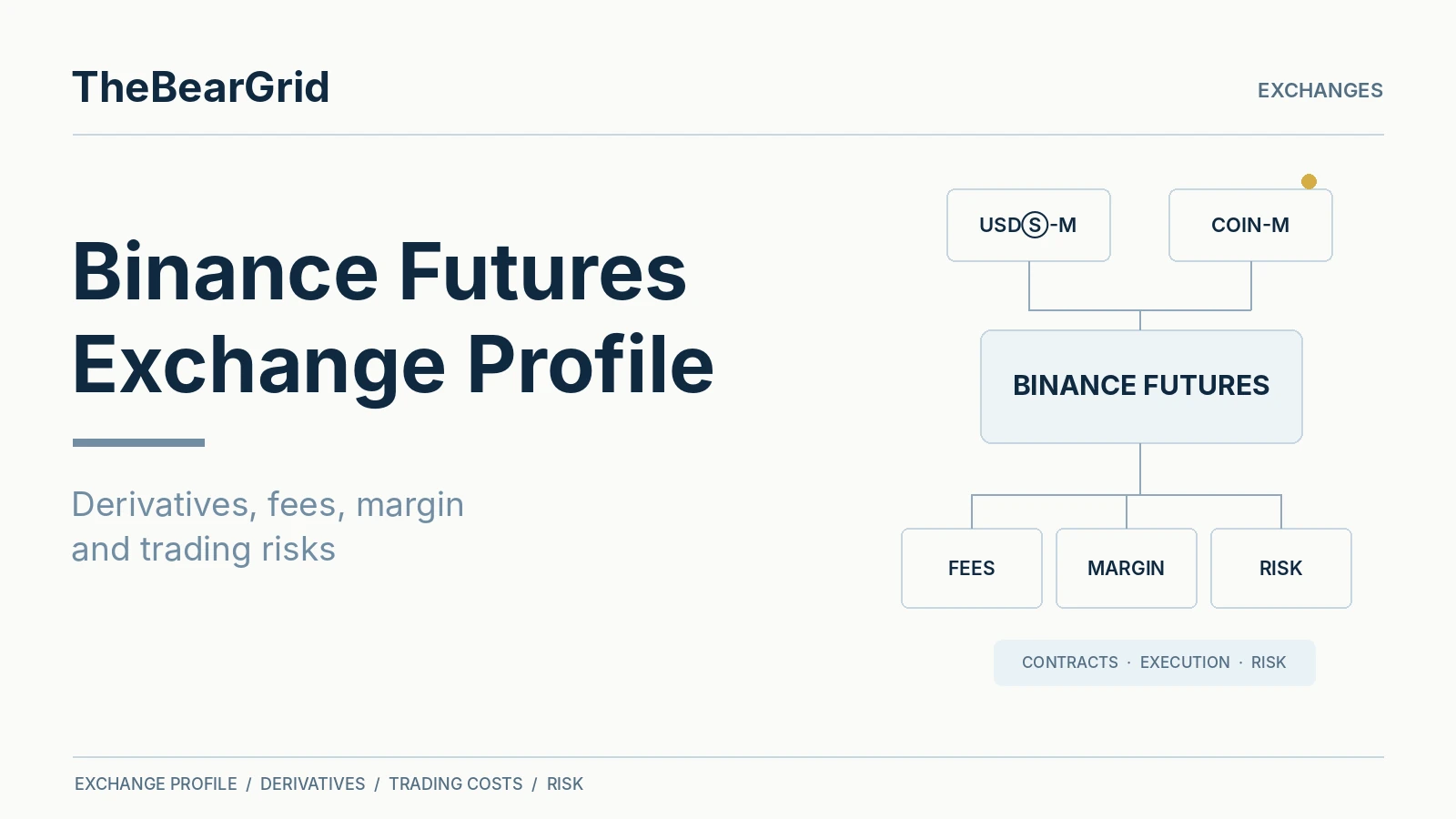
Binance offers several types of crypto derivatives contracts, including stablecoin-margined (USDⓈ-M) and coin-margined (COIN-M) futures. For traders comparing cryptocurrency exchanges, these products provide different ways to obtain leveraged exposure, manage collateral, and structure trading positions.
But evaluating Binance Futures requires more than reviewing its available contracts or advertised fee rates. The actual trading experience depends on contract specifications, execution costs, margin settings, funding payments, and the exchange’s risk-management procedures. There is also an important distinction between a product being listed on Binance and that product being available to a particular user.
This profile examines Binance’s derivatives trading structure using official exchange documentation, focusing on the costs, trading conditions, and risks that matter when evaluating a futures trading venue. The analysis is based on published information rather than hands-on trading tests or independent measurements of Binance’s execution performance.
Table of Contents
1. Binance Futures: Products and Contract Structure
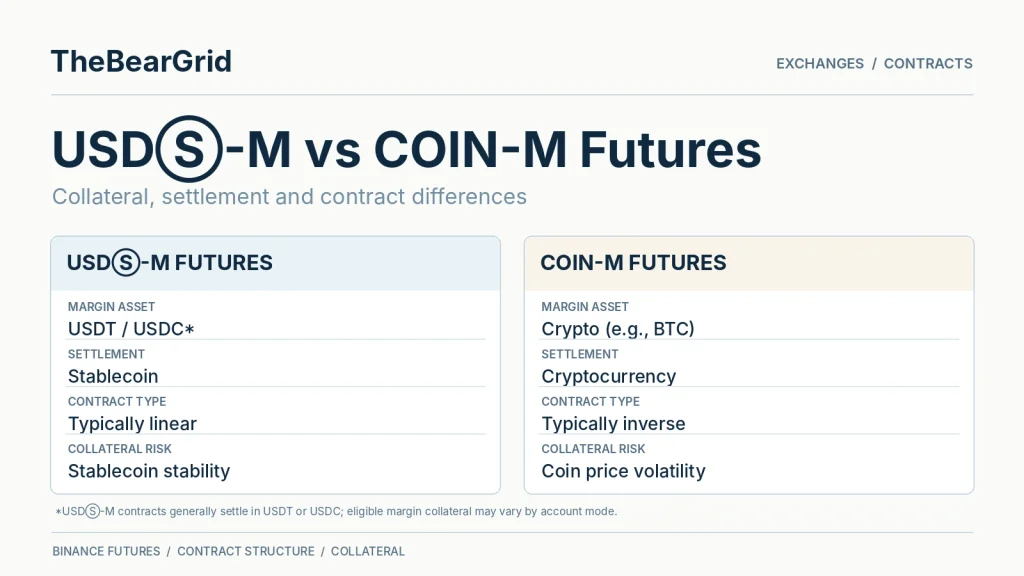
Binance organizes its core cryptocurrency futures offering into two major categories: USDⓈ-Margined (USDⓈ-M) Futures and COIN-Margined (COIN-M) Futures. Both provide exposure to cryptocurrency price movements, but their collateral and settlement structures differ.
USDⓈ-M Futures
These contracts are settled in supported dollar-denominated assets, primarily USDT or USDC. For example, a BTCUSDT perpetual futures contract allows a trader to obtain exposure to Bitcoin price movements while accounting for profits and losses in USDT.
This structure makes it relatively straightforward to measure returns, trading fees, and margin requirements in a dollar-denominated unit. It can be useful for traders who prefer to manage their derivatives exposure separately from the price fluctuations of cryptocurrency-denominated collateral.
However, stablecoin-denominated collateral is not risk-free. Traders remain exposed to the stability, liquidity, and operational risks associated with the settlement asset itself.
Binance also supports additional eligible collateral assets through certain account configurations, including Multi-Assets Mode, which is discussed later in this article.
COIN-M Futures
COIN-M Futures use cryptocurrency assets as collateral and settlement assets. For example, a BTC-margined futures contract generally uses Bitcoin as margin, with profits and losses also accounted for in BTC.
This creates a different risk profile from a USDT-margined contract. A trader holding Bitcoin collateral is exposed to both the derivatives position and changes in the dollar value of the collateral.
For a leveraged long position, falling Bitcoin prices can create pressure from two directions: losses on the derivatives position and a decline in the dollar value of the BTC collateral supporting it.
The exact financial impact depends on the contract structure, position direction, and settlement calculations.
USDⓈ-M vs. COIN-M Futures
| Feature | USDⓈ-M Futures | COIN-M Futures |
|---|---|---|
| Typical margin asset | USDT, USDC, or other eligible collateral | Cryptocurrency |
| Settlement asset | USDT or USDC, depending on contract | Cryptocurrency |
| Contract structure | Commonly linear | Commonly inverse |
| Main collateral consideration | Stablecoin stability and margin risk | Crypto collateral price volatility |
| Funding mechanism | Applies to perpetual contracts | Applies to perpetual contracts |
Binance offers both perpetual and delivery-based futures structures. Perpetual futures do not have a scheduled expiration date, while delivery futures have defined settlement terms.
Importantly, Binance’s futures products should not be treated as interchangeable simply because they reference the same underlying cryptocurrency. Collateral, settlement, contract multipliers, and risk calculations can differ.
For an introduction to perpetual futures mechanics, see What Are Perpetual Futures?.
2. Binance Futures Trading Fees
Binance uses a maker-taker fee structure for futures trading. A maker order adds liquidity to the order book, while a taker order removes existing liquidity.
The applicable trading fee depends on several factors, including the user’s VIP tier, contract category, and eligible discounts or promotions.
Maker and Taker Fee Structure
Binance’s official futures fee documentation uses the following hypothetical rates to illustrate the fee calculation for a regular user trading standard USDⓈ-M futures.
| Fee Type | Illustrative Rate |
|---|---|
| Maker | 0.0200% |
| Taker | 0.0500% |
| Maker with eligible 10% BNB discount | 0.0180% |
| Taker with eligible 10% BNB discount | 0.0450% |
These rates are useful for understanding how the fee structure works, but they should not be interpreted as guaranteed current rates for every Binance futures contract.
Binance maintains separate fee schedules for USDⓈ-M and COIN-M products. Certain contracts may also have promotional trading fees or other special arrangements.
The actual fee charged must therefore be verified using the applicable contract and account-level fee schedule.
VIP Tiers and BNB Discounts
Binance offers trading fee tiers that can reduce commissions for qualifying accounts. Eligibility depends on factors such as trading activity, BNB holdings, and other applicable program conditions.
However, traders should not assume that institutional or higher-tier fees apply to standard retail accounts.
Similarly, the published 10% BNB discount on eligible standard USDⓈ-M futures fees is conditional. Traders must have sufficient BNB in the relevant futures account and meet the applicable requirements.
The discount should not be assumed to apply to every contract or combine automatically with promotional rates.
When comparing Binance with another exchange, the relevant question is not which platform advertises the lowest possible fee, but which fee applies to the trader’s actual account and intended contract.
Why Order Execution Matters
Submitting a limit order does not automatically guarantee a maker fee. If the order executes immediately against existing liquidity, the filled portion is classified as taker activity.
Binance also supports Post-Only orders, which are designed to prevent immediate taker execution. If a Post-Only order would immediately match existing liquidity, it is canceled rather than executed as a taker order.
While this helps traders avoid unintended taker fees, it introduces a trade-off: the order may never execute.
Lower maker commissions can be valuable, but execution probability and price movement also influence the final trading outcome.
3. What Does a Binance Futures Trade Actually Cost?
Trading commissions become more meaningful when calculated using a realistic position size.
Consider a hypothetical trader opening a BTCUSDT perpetual futures position with the following assumptions:
| Variable | Value |
|---|---|
| Position notional | $20,000 |
| Initial margin | $2,000 |
| Leverage | 10× |
| Maker fee | 0.02% |
| Taker fee | 0.05% |
The example uses illustrative fee rates rather than a live account-specific quotation. It also assumes that the entry and exit transactions have identical notional values.
Taker Entry and Exit
If the trader opens and closes the position using taker orders, the commissions are:
- Opening commission: $20,000 × 0.0005 = $10
- Closing commission: $20,000 × 0.0005 = $10
- Total trading commission: $20
This $20 commission represents 0.10% of the position’s notional value. Relative to the $2,000 initial margin committed to the trade, however, it represents 1%.
The fee rate itself has not increased. Its impact relative to committed capital is greater because the trader controls a larger position through leverage.
Maker Entry and Exit
If the trader successfully executes both transactions as maker orders, the commissions are:
- Opening commission: $20,000 × 0.0002 = $4
- Closing commission: $20,000 × 0.0002 = $4
- Total trading commission: $8
The maker scenario saves $12 in explicit trading commissions.
However, this comparison excludes execution prices, spreads, slippage, and funding payments. A resting maker order may remain unfilled, while waiting for execution can expose the trader to unfavorable market movements.
Therefore, lower maker fees do not necessarily translate into a better overall trading result.
Adding a Funding Payment
Suppose the trader holds the position through one funding settlement at a hypothetical positive funding rate of 0.01%.
Assuming a $20,000 position value at settlement, a long trader would pay an additional:
$20,000 × 0.0001 = $2
The combined expenses become:
| Cost Component | Taker Entry & Exit | Maker Entry & Exit |
|---|---|---|
| Trading commissions | $20 | $8 |
| Funding paid | $2 | $2 |
| Combined expense | $22 | $10 |
| Expense as % of $2,000 margin | 1.10% | 0.50% |
Illustrative calculation. Assumes equal entry and exit notional values, one identical positive funding settlement, and no additional execution-price costs.
This illustrates an important principle for leveraged traders: seemingly small percentage-based costs can become meaningful relative to committed capital.
If a trader increases leverage to establish a larger notional position with the same margin, the absolute commission burden also increases.
However, increasing leverage alone does not change the trading fee on a position whose notional size remains unchanged.
For a more detailed discussion of commissions, spreads, slippage, and funding payments, see Crypto Perpetual Futures Trading Fees Explained: The Real Cost of Trading.
4. Binance Liquidity and Order Execution
Liquidity is an important consideration when evaluating a futures trading venue, but reported trading volume should not be treated as a direct measurement of execution quality.
A market can generate substantial trading activity while displaying limited order book depth at the price levels relevant to a particular trader.
The actual cost of execution depends on the liquidity available when an order reaches the market.
What Should Traders Examine?
Three indicators are particularly useful when assessing futures trading conditions.
Bid-Ask Spread: The difference between the best available bid and ask prices. A narrower spread generally reduces the immediate cost of crossing the market, especially for smaller orders.
Order Book Depth: The quantity of resting orders available across different price levels. Depth becomes important when an order is too large to execute entirely at the best available price.
Slippage: The difference between a chosen reference price and the actual average execution price. Slippage can increase when liquidity is limited or market conditions change rapidly.
These factors help explain why an exchange offering lower trading commissions may not necessarily provide lower overall trading costs.
BTCUSDT Liquidity Cannot Represent Every Binance Market
A common analytical mistake is assuming that execution conditions in a major contract like BTCUSDT represent those of every futures product on the exchange.
Liquidity can vary significantly between contracts. A heavily traded Bitcoin perpetual market may have a very different order book structure from a smaller altcoin perpetual market.
Execution conditions can also deteriorate during periods of heightened volatility, concentrated liquidations, or sudden changes in market participation.
Therefore, evaluating Binance Futures requires contract-level analysis rather than assumptions based on exchange-wide trading volume.
The Limits of This Profile’s Liquidity Assessment
This article does not include independently captured Binance order book snapshots, controlled execution tests, or measured slippage across exchanges.
Consequently, it does not assign Binance a liquidity ranking or claim that its execution quality is superior to competing venues.
A meaningful comparison would require matched contracts, consistent timestamps, comparable order sizes, and repeatable measurements of spreads and market depth.
For more on this distinction, see Why Crypto Exchange Trading Volume Doesn’t Equal Liquidity.
5. Leverage, Margin Modes, and Liquidation Rules
The risk of trading Binance Futures depends partly on how collateral supports leveraged positions.
Leverage allows traders to establish exposure larger than their initial margin. It also increases the impact of adverse price movements relative to the capital committed.
Binance supports different margin configurations, including Isolated Margin and Cross Margin.
Isolated Margin vs. Cross Margin
Isolated Margin allocates collateral to an individual position, generally limiting the funds directly exposed to that position.
However, traders can add margin to isolated positions, and applicable account features or margin adjustments may change the amount committed.
Isolated Margin does not eliminate liquidation risk. A position can still be liquidated when the collateral supporting it becomes insufficient.
Cross Margin allows eligible collateral to be shared across relevant positions. This provides greater flexibility, but losses on one position can reduce the margin available to support others.
The precise scope of shared collateral depends on the contract category and account configuration.
| Feature | Isolated Margin | Cross Margin |
|---|---|---|
| Collateral allocation | Position-specific | Shared eligible collateral |
| Risk exposure | More separated | More interconnected |
| Margin flexibility | Requires position-level allocation or adjustment | Can draw on eligible shared balances |
| Main consideration | Allocated collateral can be lost | Losses can affect other supported positions |
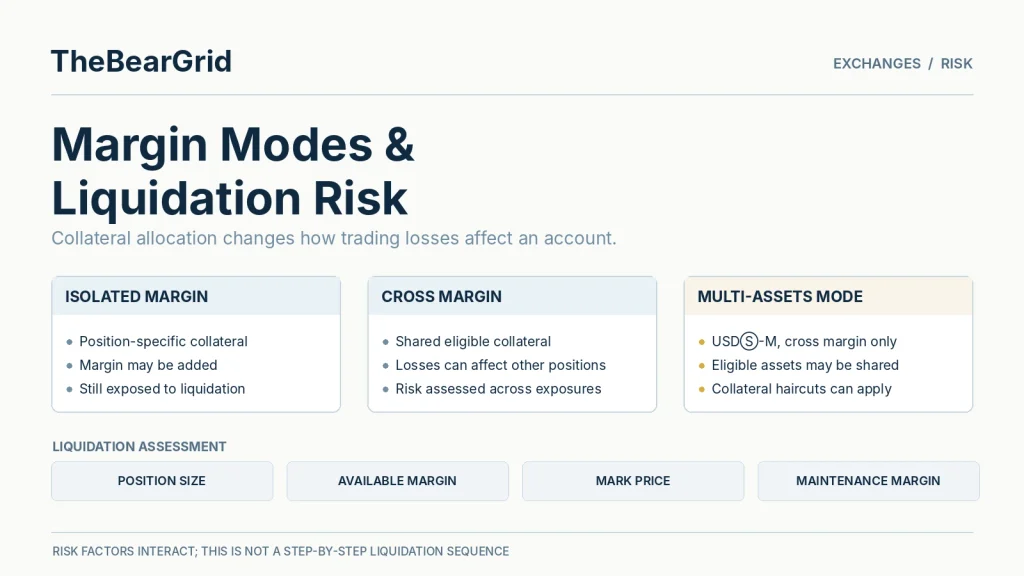
Neither mode is universally safer under every trading strategy. The relevant trade-off is between collateral separation and the flexibility of shared margin.
Multi-Assets Mode
Binance’s USDⓈ-M Multi-Assets Mode allows eligible assets, including supported cryptocurrencies, to be used as collateral alongside stablecoins.
For example, eligible holdings of BTC, ETH, or BNB may contribute to the collateral supporting USDⓈ-M futures exposure.
However, Multi-Assets Mode operates exclusively in Cross Margin Mode.
Certain collateral assets are subject to valuation discounts, or haircuts, meaning their recognized collateral value may be lower than their market value.
While this structure can improve capital flexibility, it also introduces additional exposure to collateral price fluctuations.
A decline in the value of crypto collateral may reduce available margin at the same time as a derivatives position moves against the trader.
How Binance Triggers Liquidation
Binance Futures uses Mark Price, rather than Last Traded Price, for liquidation triggers.
Mark Price incorporates reference market prices and funding-related components. Its methodology is designed to reduce the influence of isolated price anomalies, although it does not eliminate liquidation risk.
A position may be liquidated when its available collateral is insufficient to satisfy the applicable maintenance margin requirement.
The liquidation threshold depends on several factors, including position exposure, collateral, unrealized profit and loss, maintenance margin requirements, and relevant account adjustments.
Binance applies position-based risk brackets when determining maintenance margin requirements.
As a position crosses specified notional thresholds, its maintenance margin rate may increase. Positions within the same bracket can remain subject to the same rate despite differences in size.
Consequently, two positions using identical leverage can have different liquidation buffers depending on their notional exposure, applicable risk bracket, and collateral conditions.
Liquidation should therefore not be viewed as a simple function of leverage alone.
For a detailed explanation of these mechanisms, see How Crypto Futures Liquidation Works.
6. Funding Rates, Insurance Funds, and Auto-Deleveraging
Perpetual futures carry risks that extend beyond initial margin requirements and ordinary trading fees.
Evaluating Binance’s derivatives infrastructure requires understanding how the exchange handles funding payments and stressed positions.
Funding Rates
Funding rates are periodic payments exchanged between long and short perpetual futures position holders.
When funding is positive, long positions generally pay short positions. When funding is negative, short positions generally pay long positions.
Binance commonly uses an eight-hour funding interval, but settlement frequency can differ by contract and may change under specified market conditions.
Because funding rates and settlement schedules can change, the cost of maintaining a position cannot be reliably estimated from a single snapshot of the current rate.
Funding payments are generally transferred between traders holding opposing positions rather than collected by Binance as conventional trading commissions.
For traders maintaining leveraged exposure over longer periods, these payments may become an important part of overall trading performance.
For a deeper explanation, see Crypto Funding Rate Explained.
Insurance Funds
Binance operates futures insurance funds designed to mitigate certain losses arising from bankrupt liquidated positions.
When a position cannot be closed without creating a shortfall beyond the collateral available to support it, the relevant insurance fund may absorb the resulting loss under applicable rules.
These funds are part of the exchange’s derivatives risk-management system.
However, the term insurance fund should not be confused with an insurance policy protecting traders’ deposited capital.
Binance’s futures insurance funds are not insurance products and do not guarantee compensation for trading losses.
Their purpose is to manage specific counterparty risks arising from futures liquidations.
Auto-Deleveraging (ADL)
Under extreme market conditions, the normal liquidation process and available insurance fund capacity may be insufficient to absorb bankrupt positions.
In such circumstances, Binance may activate Auto-Deleveraging (ADL).
ADL can automatically reduce or close selected positions on the opposite side of a bankrupt trade.
Binance determines ADL priority through a ranking system that considers both profitability and effective leverage.
As a result, a trader holding a profitable position may have that exposure reduced without personally breaching a maintenance margin requirement.
This is a different risk from the liquidation of an under-margined position.
It means a trader can face an involuntary reduction in exposure during exceptional market stress, even when the position itself remains profitable.
Why These Mechanisms Matter
Insurance funds and ADL are important elements of an exchange’s derivatives risk-management framework.
However, the existence of these mechanisms does not establish that an exchange is free from counterparty risk.
A more meaningful assessment considers how the mechanisms operate, the conditions under which they are triggered, and the limitations of the protection they provide.
These are especially relevant when comparing exchanges during periods of market stress.
7. Regional Availability and Key Risks
One of the most important considerations when evaluating Binance is whether the relevant derivatives products are available to the intended user.
Cryptocurrency exchanges may operate internationally while restricting specific services in individual jurisdictions.
Product availability can depend on the customer’s verified location, account eligibility, the entity providing the service, and applicable local regulations.
Product Availability Is Jurisdiction-Specific
Binance has historically announced restrictions affecting derivatives services in jurisdictions including Hong Kong and several European markets.
However, historical notices should not be treated as a complete representation of current restrictions.
Traders must verify the latest applicable rules and account eligibility for their jurisdiction.
The fact that the Binance website is accessible in a particular country does not establish that futures trading is available there.
Likewise, access to spot trading does not necessarily imply access to derivatives.
Main Risks to Consider
| Risk Category | Practical Consideration |
|---|---|
| Leverage and liquidation | Adverse market movements can rapidly erode margin |
| Funding costs | Holding expenses can change over time |
| Execution risk | Spreads and slippage may increase during volatility |
| Collateral risk | Stablecoin or cryptocurrency collateral values may change |
| Cross-margin exposure | Losses can affect shared eligible collateral |
| Exchange and custody risk | Assets depend on the platform’s custody and operational arrangements |
| Jurisdictional risk | Services may be restricted or unavailable |
These risks are not unique to Binance, but their specific implementation depends on the exchange’s contract rules and operating structure.
Affiliate Eligibility Is Not Product Availability
There is also an important distinction between a trader’s ability to access Binance and a publisher’s permission to promote Binance products.
Binance maintains separate affiliate marketing rules that restrict promotion targeting residents of certain jurisdictions.
Its published affiliate guidance identifies restricted markets including the European Union and European Economic Area, the United Kingdom, the United States, Singapore, and Hong Kong, among others.
These restrictions apply to promotional activity and should not be confused with a complete list of countries where every Binance product is unavailable.
A review website may have access to a referral program while still being prohibited from targeting certain audiences.
The presence of a referral link should never be interpreted as evidence of regulatory availability, product suitability, or permission to promote services in a particular jurisdiction.
Evaluating Binance as a Futures Venue
Binance provides several documented features relevant to derivatives trading: USDⓈ-M and COIN-M contracts, maker-taker fee schedules, multiple margin configurations, perpetual funding mechanisms, and defined liquidation and ADL procedures.
However, these capabilities alone do not establish that Binance is the best exchange for a particular trader.
Execution quality requires independent measurement. Trading fees must be evaluated at the applicable account and contract level. Margin arrangements should be assessed against the trader’s exposure and collateral requirements.
Above all, the intended product must be available under the relevant jurisdictional rules.
A meaningful exchange evaluation should therefore focus on a specific trading use case rather than a general ranking based on features or reported volume.
Conclusion
Binance offers a derivatives trading structure built around different futures contract types, margin arrangements, and documented risk-management mechanisms.
USDⓈ-M and COIN-M contracts provide different approaches to collateral and settlement. Maker-taker commissions, funding payments, and execution prices determine the cost of trading, while Mark Price, maintenance margin requirements, insurance funds, and ADL influence how leveraged positions are managed during market stress.
Yet the presence of these features does not automatically make Binance the best venue for every trader.
Execution quality requires independent validation. Trading fees must be assessed using the relevant account tier and actual order behavior. The suitability of Cross or Isolated Margin depends on how the trader intends to manage collateral and exposure.
Most importantly, the intended product must be accessible under the applicable jurisdictional rules.
A meaningful evaluation of Binance Futures is not simply about what the exchange offers, but how its trading conditions and risk mechanisms apply to the specific exposure a trader intends to hold.
That distinction provides a stronger foundation for comparing Binance with other crypto derivatives exchanges.
Related Research
- What Are Perpetual Futures? — Understanding perpetual contracts, leverage, and funding mechanics.
- Crypto Perpetual Futures Trading Fees Explained — How maker-taker commissions, spreads, slippage, and funding affect trading costs.
- Why Crypto Exchange Trading Volume Doesn’t Equal Liquidity — Why order book depth and execution quality matter more than reported volume alone.
- How Crypto Futures Liquidation Works — Mark Price, maintenance margin, liquidation, and exchange risk mechanisms.
- How Crypto Exchanges Compete for Perpetual Futures Traders — The competitive importance of fees, liquidity, and derivatives infrastructure.
References
- Binance — What Are USDⓈ-Margined Futures and COIN-Margined Futures?. Official explanation of contract types, collateral, and settlement.
- Binance — Futures Fee Structure & Fee Calculations. Maker-taker fee methodology, VIP conditions, and calculation examples.
- Binance — How to Switch Between Cross and Isolated Margin. Margin mode configuration and restrictions.
- Binance — How to Adjust Margin Balance. Position-level collateral adjustments in Isolated Margin.
- Binance — Multi-Assets Mode. Eligible collateral, valuation adjustments, and Cross Margin requirements.
- Binance — Leverage and Margin of USDⓈ-M Futures. Position brackets and maintenance margin methodology.
- Binance — Futures Liquidation Protocols. Mark Price, liquidation triggers, and margin requirements.
- Binance — Introduction to Futures Funding Rates. Funding methodology and settlement intervals.
- Binance — Introduction to Futures Insurance Funds. Insurance fund purpose and limitations.
- Binance — Auto-Deleveraging. ADL procedures and priority ranking.
- Binance — Affiliate Program Restricted Countries Guide. Rules governing restricted-country affiliate promotion.
Source review date: October 31, 2026. This profile is based on publicly available Binance documentation rather than first-hand testing, independent execution measurements, or audited platform performance data. Trading fee examples are hypothetical. Fees, product specifications, account eligibility, and geographic restrictions may change.
Editorial independence: This profile does not constitute an endorsement or ranking of Binance. Any future commercial relationship or affiliate link should be disclosed separately and must comply with applicable promotional restrictions.
Disclaimer: This article is intended for educational and informational purposes only and does not constitute financial, investment, or legal advice. Cryptocurrency derivatives involve substantial risk, including liquidation, loss of posted collateral, and exposure to exchange and counterparty risks.