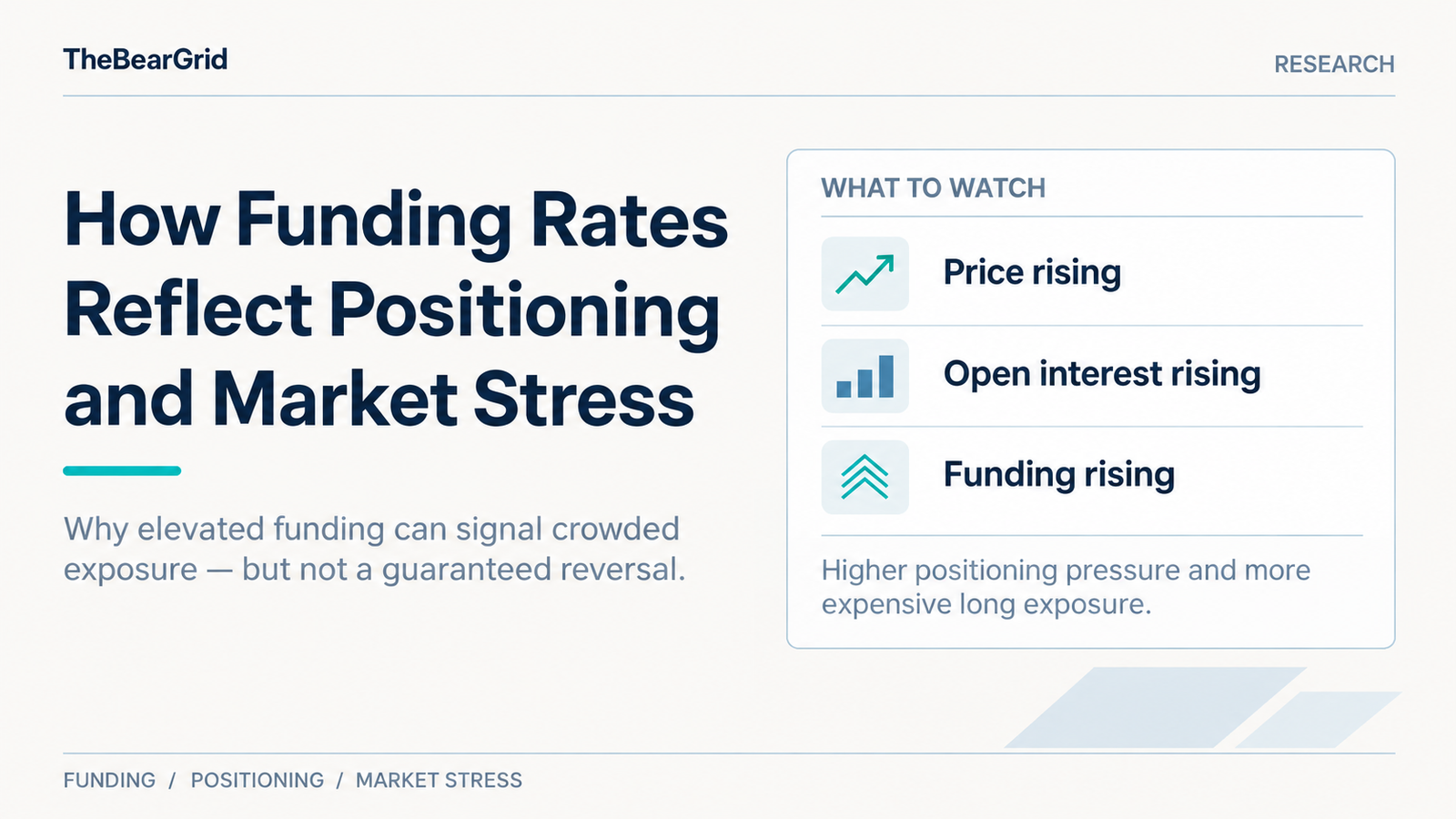
A rising funding rate often attracts attention in crypto futures markets. Traders may interpret it as a sign of bullish sentiment—or a warning that the market is becoming overheated.
But high funding does not automatically mean a price reversal is coming.
Funding rates are more useful when viewed as a measure of positioning pressure and the cost of maintaining perpetual futures exposure.
This article explains what funding can reveal, what it cannot, and how to interpret it alongside price and open interest.
Table of Contents
1. What Funding Rates Tell Us About Market Positioning
Perpetual futures use funding payments to help keep contract prices aligned with the underlying spot market.
When funding is positive, long positions pay short positions. When it is negative, shorts pay longs.
Funding rates also offer clues about demand for leveraged exposure.
| Funding Condition | Possible Interpretation |
|---|---|
| Persistently positive | Strong demand for long exposure or a sustained futures premium |
| Persistently negative | Strong demand for short exposure or a sustained futures discount |
| Near zero | Limited funding pressure, though not necessarily balanced sentiment |
These interpretations are not definitive.
Funding calculations include contract premiums and exchange-specific parameters. A positive rate does not mean there are more long contracts than short contracts: every open futures contract has both sides.
Instead, funding provides information about which side is paying to maintain exposure and how expensive that exposure has become.
2. An Example: When Rising Funding Signals Crowded Exposure
Consider a hypothetical BTC perpetual futures market over several days.
| Indicator | Observed Change |
|---|---|
| BTC price | Rises 4% |
| Open interest | Increases 10% |
| Funding rate | Rises from +0.01% to +0.04% per 8 hours |
These numbers are illustrative, not actual market observations.
Three things are happening together.
First, BTC is rising. Second, more futures contracts remain open. Third, the cost of holding long positions is increasing.
For a trader with a $20,000 BTC long position, a funding rate of +0.04% means an $8 funding payment at one settlement, assuming the position value remains unchanged.
If that rate persists across three eight-hour settlements, the simplified total becomes $24.
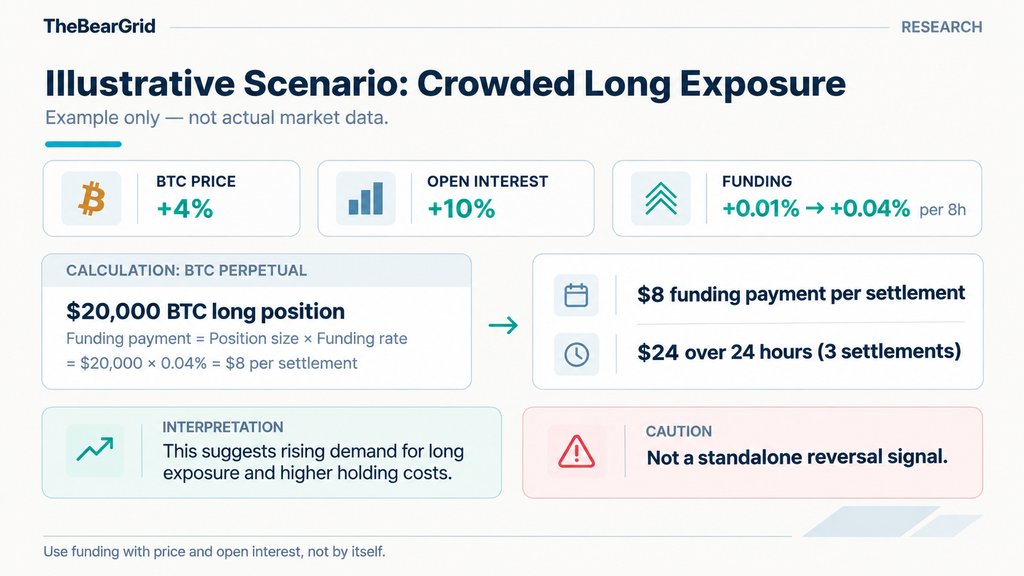
The combined picture suggests increasing demand for long exposure and greater sensitivity to changes in market conditions.
However, it does not establish that a sell-off is imminent.
The price could continue rising. Some positions may also be hedges rather than directional bets.
The relevant warning is not simply that funding is positive. It is that holding leveraged exposure has become more expensive while outstanding futures exposure is growing.
3. Why High Funding Can Accompany Market Stress
Funding rates often rise after a strong price move rather than predicting it.
As perpetual contracts trade at larger premiums, funding can increase.
This creates two potential risks for traders.
Higher holding costs. Traders maintaining positions through multiple funding settlements may pay increasingly large fees.
Greater sensitivity to reversals. If leveraged positions have accumulated during a sustained rally, an adverse price move may trigger position reductions or liquidations, depending on collateral and margin conditions.
Negative funding can create a similar concern for crowded short exposure.
But there is no universal funding-rate threshold that defines an overheated market. Contract specifications, settlement intervals, and historical conditions differ across exchanges.
4. How Traders Should Read Funding Rates
Funding becomes more useful when combined with other market information.
| Indicator | Question to Ask |
|---|---|
| Funding rate | Is holding long or short exposure becoming more expensive? |
| Open interest | Are outstanding futures positions increasing or decreasing? |
| BTC price | Is the market trending, consolidating, or reversing? |
One funding observation is rarely enough.
A sustained change across several settlements may be more informative, especially when compared with a contract’s own historical range.
Traders should also compare equivalent funding intervals and contract types rather than treating all exchange rates as directly interchangeable.
For a recent point-in-time comparison, see BTC Perpetual Funding Rates Across Exchanges: A Snapshot.
Conclusion
Funding rates can help explain how aggressively traders are seeking perpetual futures exposure and how expensive it is to maintain.
Persistently elevated funding, especially alongside rising open interest, may indicate growing positioning pressure and vulnerability to volatility.
But funding is not a standalone buy, sell, or reversal signal.
Its greatest value comes from interpreting the cost and persistence of leveraged exposure alongside price behavior and outstanding positions.
Related Research
- What Is a Funding Rate in Crypto Perpetual Futures?
- What Is Open Interest in Crypto Futures?
- BTC Perpetual Funding Rates Across Exchanges: A Snapshot
- How Crypto Futures Liquidation Works
Sources and Methodology
- Coinbase Institutional — A Primer on Perpetual Futures. Research on funding, positioning, and market volatility.
- Binance — Introduction to Futures Funding Rates. Funding mechanism and calculation components.
- OKX — Perpetual Funding Fee Mechanism. Funding settlement and position-value calculations.
Research date: November 17, 2026.
Methodology: This article explains funding-rate interpretation using exchange documentation and published institutional research. The BTC scenario is hypothetical. No current market positioning, liquidation probability, or price forecast is claimed.
Disclaimer: This article is for informational purposes only and does not constitute investment advice. Cryptocurrency derivatives involve substantial risks, including leverage, funding costs, and liquidation.