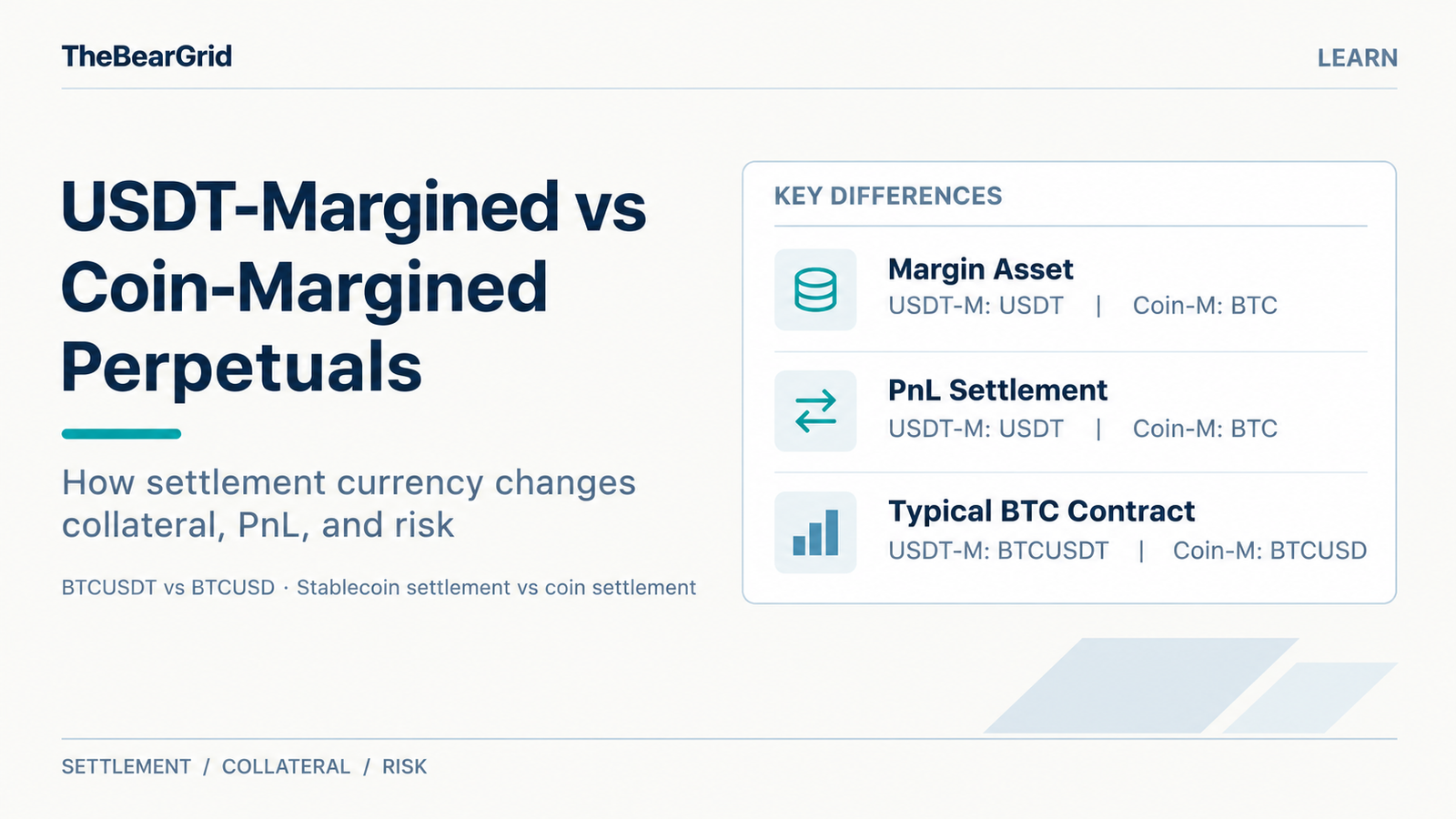
When trading BTC perpetual futures, two contracts may track the same underlying asset but produce profits and losses in different currencies.
For example, BTCUSDT perpetual futures typically settle in USDT, while BTCUSD coin-margined perpetuals settle in BTC.
That difference matters because the currency used as collateral and the currency received as profit can change a trader’s overall exposure.
This article compares the two contract types through one practical example.
Table of Contents
1. What Is the Difference Between USDT-M and Coin-M?
USDT-margined perpetual futures use USDT for margin and profit-and-loss settlement under the standard contract structure.
Coin-margined perpetual futures typically use the underlying cryptocurrency, such as BTC or ETH.
| Feature | USDT-Margined | Coin-Margined |
|---|---|---|
| Typical BTC contract | BTCUSDT | BTCUSD |
| Contract structure | Linear | Usually inverse |
| Standard margin asset | USDT | BTC |
| Profit and loss | Settled in USDT | Settled in BTC |
| Collateral value | Measured in USDT | Changes with BTC price |
| Common use | Stablecoin-based trading | Trading or hedging with existing crypto holdings |
The key distinction is not simply which contract follows BTC.
It is what asset supports the position and what asset the trader receives or pays when profits and losses are settled.
Some exchanges offer multi-asset collateral arrangements, so actual margin eligibility also depends on the account mode.
2. Example: The Same $10,000 BTC Long Position
Consider two traders opening equivalent BTC perpetual long positions.
Both start when BTC trades at $100,000.
Each position has an initial notional value of $10,000.
BTC then rises 5% to $105,000, and both traders close their positions.
Assume USDT remains approximately equal to USD.
| Item | USDT-M | Coin-M |
|---|---|---|
| BTC entry price | $100,000 | $100,000 |
| BTC exit price | $105,000 | $105,000 |
| Initial position value | $10,000 | $10,000 |
| Gross trading profit | 500 USDT | Approx. 0.004762 BTC |
| USD-equivalent profit at exit | ~$500 | ~$500 |
Illustrative example using equal initial USD exposure and a standard inverse BTCUSD contract. Excludes fees, funding, slippage, and collateral-value changes.
Both traders gain approximately $500 in USD-equivalent position profit.
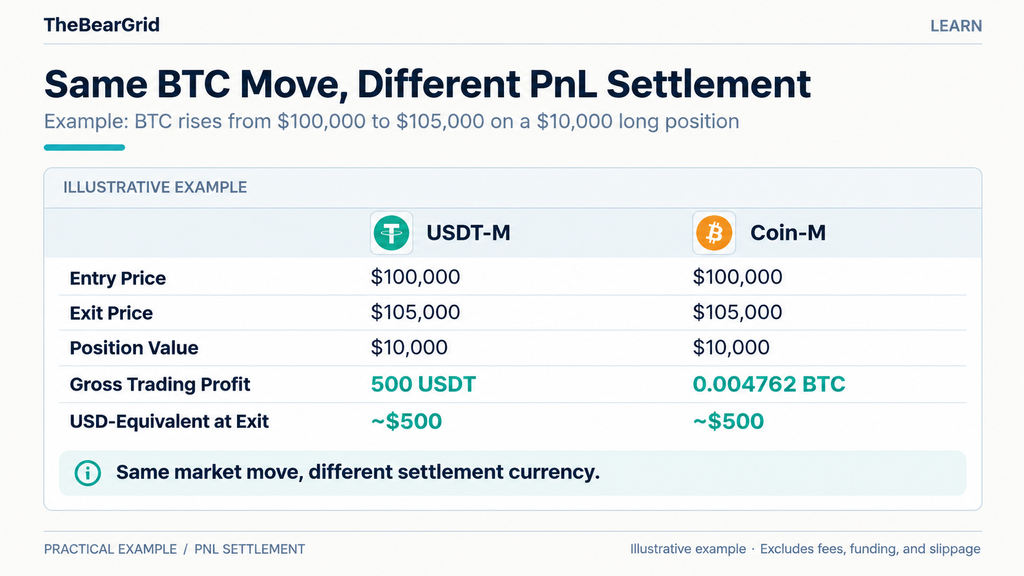
But they receive that profit in different assets.
The USDT-M trader earns 500 USDT.
The Coin-M trader earns approximately 0.004762 BTC, valued at $500 when BTC trades at $105,000.
If the Coin-M trader continues holding that BTC after closing the position, the USD value of the profit will change as BTC moves.
This is an important distinction for traders who want to accumulate cryptocurrency rather than stablecoins.
3. Why the Collateral Currency Changes Risk
The difference becomes more important when markets move against a position.
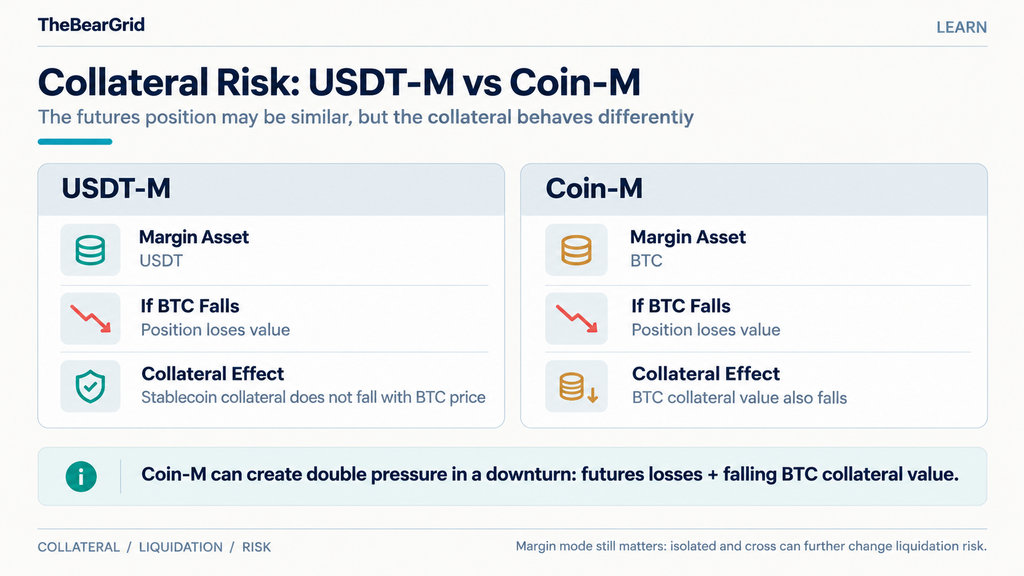
With a standard USDT-M contract, the collateral balance is denominated in USDT. The trader faces the futures position’s price risk without also holding BTC as the required margin asset.
With a BTC-margined contract, the collateral itself is BTC.
If BTC falls, the USD value of that collateral also falls.
For a BTC-margined long position, a market decline can therefore create two pressures:
- Losses on the long futures position.
- A lower USD value of the BTC held as collateral.
This can make margin management more complicated, especially when leverage is involved.
However, Coin-M is not automatically the riskier choice in every situation.
For example, a trader already holding BTC may use a coin-margined short position to hedge some of that exposure without first converting BTC into USDT.
The effectiveness of that hedge depends on position sizing, contract specifications, and trading costs.
Margin currency and margin mode are also different decisions. Both contract types may offer isolated or cross margin, depending on the exchange.
For more on collateral sharing, see Cross Margin vs Isolated Margin: Key Differences.
4. Which Contract Type Should Traders Consider?
Neither contract type is universally better.
The choice depends primarily on how the trader wants to manage collateral, profits, and existing cryptocurrency exposure.
When USDT-M May Be More Practical
USDT-M is often easier for traders who:
- Already hold USDT as trading capital.
- Want to track trading profit and loss in stablecoin units.
- Prefer not to use BTC as the standard margin asset.
- Trade several crypto markets using a common settlement currency.
This does not eliminate liquidation risk or risks associated with the stablecoin itself.
When Coin-M May Be More Useful
Coin-M may be relevant for traders who:
- Already hold BTC or another supported cryptocurrency.
- Want futures profits settled in that cryptocurrency.
- Prefer not to convert existing crypto holdings into stablecoins.
- Need coin-denominated positions for a particular hedging strategy.
The trade-off is that collateral value and settlement profits remain exposed to cryptocurrency price movements.
Traders should also compare fees, funding rates, liquidation conditions, and contract specifications before choosing.
Conclusion
USDT-margined and coin-margined perpetual futures can provide similar underlying market exposure, but their settlement and collateral structures differ.
USDT-M settles trading results in USDT, while Coin-M typically settles them in the underlying cryptocurrency.
That difference affects how profits are held, how collateral values change, and how traders manage risk.
For most traders, the starting question should be simple: Do I want to manage this futures position using stablecoins or cryptocurrency?
The answer helps determine which contract structure fits their existing holdings and trading strategy.
Related Research
- What Are Perpetual Futures?
- Cross Margin vs Isolated Margin: Key Differences
- Crypto Perpetual Futures Trading Fees Explained
- Bitget Exchange Profile: Derivatives, Fees, and Risks
Sources and Methodology
- Binance — What Are USDⓈ-Margined and COIN-Margined Futures?. Collateral and settlement differences.
- Bybit — USDT Contract P&L Calculations. Linear futures profit and loss.
- Bybit — Inverse Contract P&L Calculations. Coin-settled inverse contract calculations.
- OKX — Crypto-Margined vs USDT-Margined Futures. Contract structure, settlement, and collateral exposure.
- Bitget — USDT-M, USDC-M, and Coin-M Futures Explained. Product types and practical use cases.
Research date: November 18, 2026.
Methodology: This article compares standard linear USDT-margined and inverse coin-margined perpetual futures using official exchange documentation. The BTC scenario is hypothetical, assumes equivalent initial USD exposure, and excludes trading fees, funding, slippage, and liquidation effects. Actual results depend on contract specifications and account settings.
Disclaimer: This article is for informational purposes only and does not constitute investment advice. Cryptocurrency derivatives involve substantial risks, including leverage, liquidation, funding costs, collateral-price fluctuations, and counterparty exposure.
Availability note: Available products and account features may be restricted depending on the user’s jurisdiction.