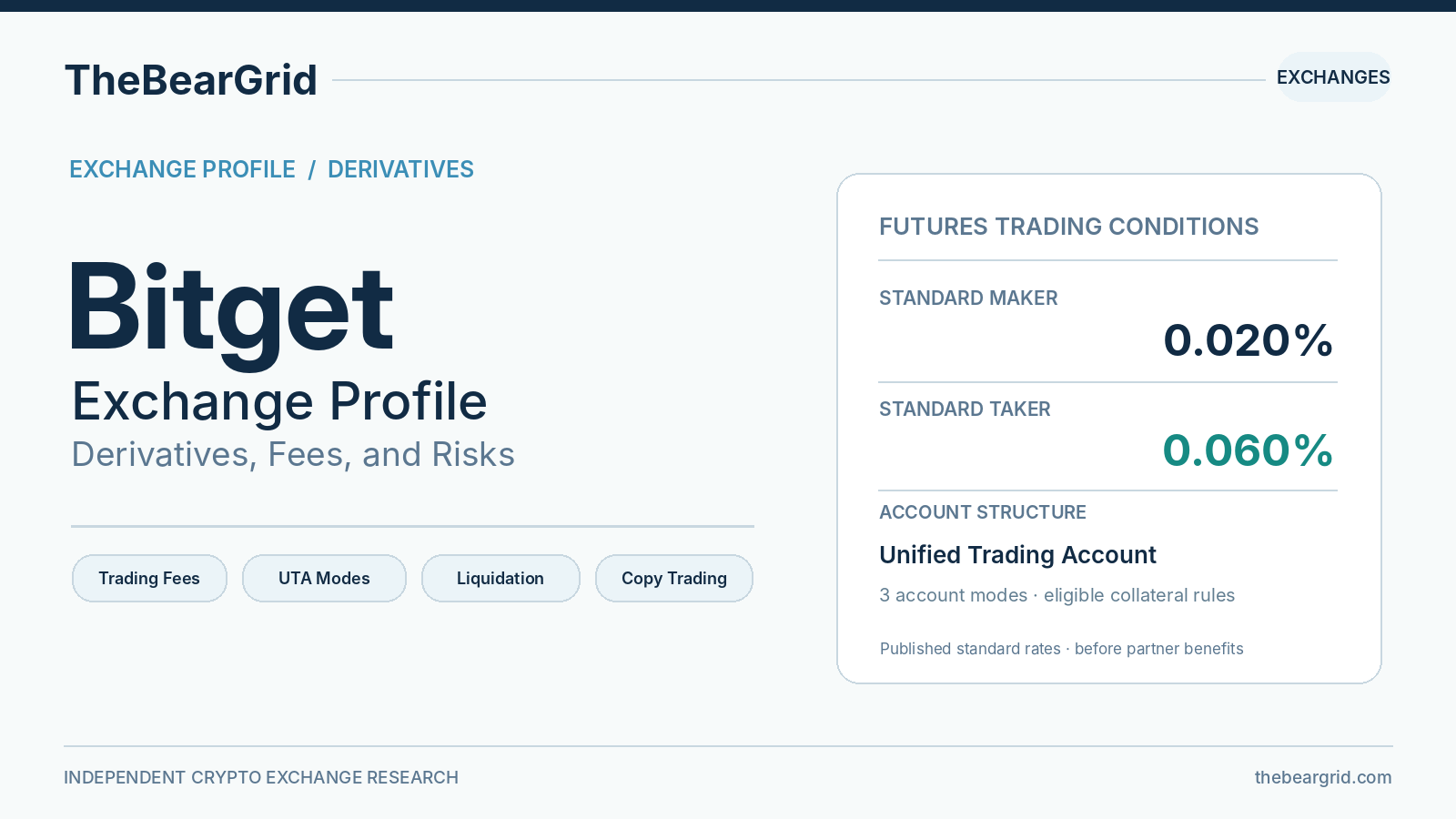
Bitget offers cryptocurrency derivatives trading across several contract types, alongside futures copy trading and a unified account structure for managing eligible collateral.
For perpetual futures traders, the platform’s main considerations are not simply the number of markets available. Trading fees, settlement currencies, margin arrangements, and liquidation procedures all affect the cost and risk of holding a position.
Bitget also updated the naming of its Unified Trading Account (UTA) modes in October 2026, making its collateral framework an important feature to examine.
This profile reviews Bitget’s futures products, published trading fees, margin system, and risk controls using official documentation available as of November 16, 2026.
The analysis does not include firsthand execution testing or independently measured order-book liquidity.
Affiliate disclosure: TheBearGrid is a Bitget affiliate partner and may earn commissions from qualifying activity through the partner link in this article. This relationship does not determine the conclusions of this profile.
Table of Contents
1. Bitget Futures Products and Contract Types
Bitget offers derivatives products with different settlement arrangements.
The main distinction is between stablecoin-margined contracts and cryptocurrency-margined contracts.
| Contract Type | Settlement Asset | Expiration |
|---|---|---|
| USDT-M Perpetual | USDT | None |
| USDC-M Perpetual | USDC | None |
| Coin-M Perpetual | Cryptocurrency | None |
| Coin-M Delivery Futures | Cryptocurrency | Fixed expiry |
Stablecoin-Margined Futures
USDT-M and USDC-M perpetual futures settle profits and losses in their respective stablecoins.
For example, a BTCUSDT perpetual position generates USDT-denominated profit or loss based on movements in the contract price.
This allows traders to measure their derivatives exposure without directly holding BTC as the settlement asset.
However, stablecoin settlement does not remove leverage, liquidation, or settlement-asset risks.
Coin-Margined Futures
Coin-M contracts use cryptocurrency as the settlement asset.
A BTC-margined position can therefore be affected by changes in both the derivatives position and the value of the cryptocurrency used as collateral.
Bitget also supports Coin-M delivery futures, which expire according to the contract’s settlement schedule.
Unlike perpetual futures, delivery futures have a fixed expiration date and do not use ongoing perpetual funding payments.
For traders comparing these products, the relevant questions are how collateral is valued, how profit and loss are calculated, and whether the contract has a funding mechanism or scheduled expiration.
For the underlying concepts, see What Are Perpetual Futures?.
2. Bitget Trading Fees: What Does a Futures Position Cost?
Bitget uses maker and taker fees for its futures markets.
Its published standard futures rates are:
| Fee Type | Standard Rate |
|---|---|
| Maker | 0.020% |
| Taker | 0.060% |
These are baseline rates rather than guaranteed fees for every account. VIP levels and eligible fee arrangements can change the amount charged.
Example: A $20,000 BTC Perpetual Position
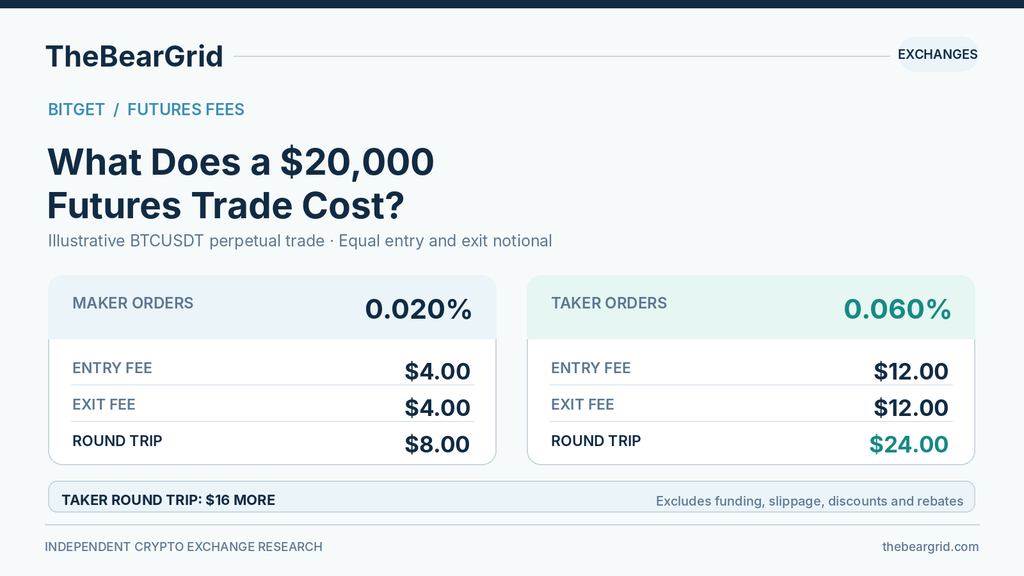
Assume a trader opens and closes a $20,000 BTCUSDT perpetual position.
The notional value remains unchanged, and both orders use the same execution type.
| Trading Cost | Maker Orders | Taker Orders |
|---|---|---|
| Entry Fee | $4.00 | $12.00 |
| Exit Fee | $4.00 | $12.00 |
| Total Fees | $8.00 | $24.00 |
Trading Fee = Executed Notional × Applicable Fee Rate
Under these assumptions, executing both sides as taker orders costs $16 more than executing both sides as maker orders.
This does not mean maker orders always deliver a better outcome.
A maker order may not fill immediately or completely, while a taker order may incur slippage or a wider effective spread.
The example also excludes funding fees and any applicable discounts or rebates.
Bitget publishes separate VIP and fee-related incentive arrangements. Their application to a particular futures account and compatibility with other benefits should be confirmed before calculating a discounted trading cost.
For more on total execution expenses, see Crypto Perpetual Futures Trading Fees Explained.
3. Bitget Unified Trading Account and Margin Modes
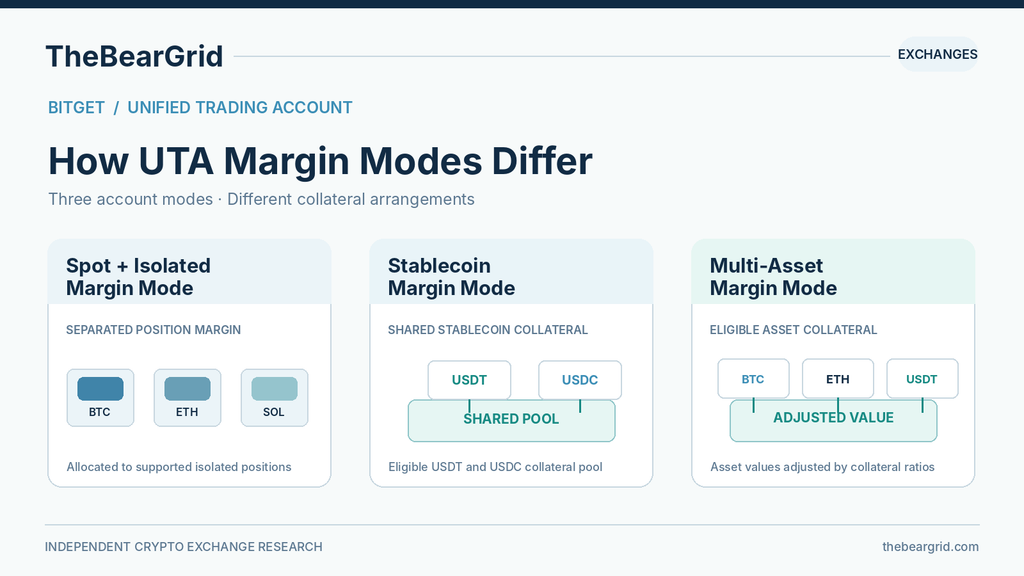
Bitget’s Unified Trading Account supports different approaches to collateral management.
In October 2026, the exchange announced updated names for its three account modes. The change was intended to clarify how margin is used and did not itself change the underlying trading logic.
| UTA Account Mode | Main Collateral Arrangement |
|---|---|
| Spot + Isolated Margin Mode | Separate margin for supported isolated futures positions |
| Stablecoin Margin Mode | Shared eligible USDT and USDC collateral |
| Multi-Asset Margin Mode | Multiple eligible assets valued using collateral ratios |
Isolated Margin
In isolated arrangements, margin is allocated to individual positions.
This helps separate the risk of one derivatives position from other eligible positions, although the amount at risk can change when additional margin is allocated.
Cross Margin and Multi-Asset Collateral
Cross margin allows eligible collateral to support multiple positions.
This can improve capital efficiency by reducing the need to maintain separate collateral balances for each trade.
However, losses on one position can reduce the margin available to support others.
Under Bitget’s Multi-Asset Margin Mode, supported assets contribute collateral according to their applicable collateral ratios.
This is important because the market value of an asset is not necessarily equal to its recognized margin value.
A trader should therefore review adjusted equity, collateral eligibility, and account-level risk indicators rather than relying only on the total account balance.
The selected account mode also determines which products and collateral arrangements are supported.
Read Cross Margin vs Isolated Margin: Key Differences for a practical comparison.
4. Liquidation and Risk Management
Bitget uses mark-price-based risk controls and maintenance margin requirements to manage leveraged positions.
The liquidation process depends on the account configuration and the risk associated with the position or collateral pool.
What Happens When Margin Becomes Insufficient?
In isolated mode, liquidation risk is primarily assessed against the relevant position’s available margin and liquidation price.
In cross-margin arrangements, the account’s broader collateral condition becomes important.
Bitget’s Unified Trading Account documentation describes risk restrictions and position-reduction procedures that may occur before full account liquidation.
For example, increasing maintenance margin requirements relative to available equity can restrict new orders and trigger risk-reduction measures.
These procedures are not a guarantee that a trader will avoid losses.
Insurance Fund and Auto-Deleveraging
Bitget maintains an Insurance Fund intended to address certain liquidation shortfalls.
If the relevant fund cannot absorb losses under extreme conditions, auto-deleveraging (ADL) may reduce positions held by other traders.
The Insurance Fund is not insurance against a trader’s personal losses.
This distinction matters because risk controls help manage the exchange’s settlement process, but do not make leveraged trading loss-free.
See How Crypto Futures Liquidation Works for additional context.
5. Funding Rates and Futures Copy Trading
Perpetual Funding Costs
Like other perpetual futures venues, Bitget uses funding payments between long and short position holders.
When funding is positive, longs generally pay shorts. Negative funding reverses that direction.
Funding intervals and rates depend on contract specifications and market conditions.
Funding Fee = Position Value × Funding Rate
A position held across multiple funding settlements can accumulate costs even without an equivalent change in the underlying market price.
Traders should inspect the actual contract’s funding interval and next settlement rate rather than assuming that a single displayed percentage represents a full day’s cost.
For a general explanation, see What Is a Funding Rate in Crypto Perpetual Futures?.
Futures Copy Trading
Bitget also offers futures copy trading, allowing users to automatically replicate eligible traders’ positions.
This is a distinct feature from placing perpetual futures orders directly.
Under Bitget’s updated futures copy-trading framework, copied positions are managed through dedicated copy-trading accounts, separate from the user’s main futures trading account.
Users can configure trade allocation and supported risk controls, subject to the platform’s copy-trading rules.
The total cost may include:
- Standard futures trading fees
- Perpetual funding payments
- Profit-sharing fees payable to the copied trader when applicable
Bitget’s updated futures copy-trading system also uses a High Water Mark approach to profit sharing, under which the relevant trader’s profit share is calculated from eligible new profits rather than repeatedly charging for previously settled gains.
Copy trading introduces execution differences. A follower may receive a different entry price, position size, or result from the trader being copied.
As a result, historical performance displayed on a trader’s profile should not be interpreted as a guaranteed return for followers.
6. Evaluating Bitget as a Derivatives Exchange
Bitget combines several features that may be relevant to futures traders: multiple settlement currencies, different UTA collateral modes, and a dedicated copy-trading product.
However, these features should be evaluated alongside trading costs and risk exposure.
| Trading Priority | What to Verify |
|---|---|
| Frequent market orders | Actual taker fee and slippage |
| Limit-order trading | Maker fee and fill quality |
| Multiple futures positions | UTA margin mode and collateral sharing |
| Overnight positions | Funding rates and settlement intervals |
| Copy trading | Profit sharing, execution differences, and risk limits |
| Liquidation management | Maintenance margin, risk indicators, and ADL exposure |
Bitget’s published features do not, by themselves, demonstrate superior liquidity, execution quality, or safety compared with other exchanges.
Those comparisons require matched market data, equivalent orders, and evidence covering the relevant contracts.
Bitget Partner Trading Fee Benefits
TheBearGrid is an affiliate partner of Bitget.
Under our current partner arrangement, eligible referred users may qualify for a 20% trading-fee benefit, subject to Bitget’s applicable program terms.
Referral Code: BGRID
View Bitget Partner Trading Conditions
The benefit mechanism, eligible products, account requirements, settlement conditions, and compatibility with VIP or other fee programs should be confirmed before registration.
These partner benefits are separate from the standard trading fees discussed earlier in this article.
Affiliate disclosure: The link above is an affiliate link. TheBearGrid may receive commissions from qualifying activity associated with this referral. Partner compensation does not determine whether Bitget is suitable for a particular trader.
Conclusion
Bitget offers a broad set of crypto futures products, with standard published maker and taker fees of 0.020% and 0.060%, respectively.
Its Unified Trading Account provides different collateral arrangements, while futures copy trading introduces another way to participate in derivatives markets.
The main considerations are the actual trading cost, the extent of collateral sharing, and how the platform manages liquidation risk.
Bitget is worth evaluating for its derivatives product structure and account flexibility, but its suitability depends on the trader’s specific strategy and risk requirements.
Product features and published fee rates should not replace contract-level checks or independent risk assessment.
Related Research
- What Are Perpetual Futures?
- Crypto Perpetual Futures Trading Fees Explained
- Cross Margin vs Isolated Margin: Key Differences
- How Crypto Futures Liquidation Works
- What Is a Funding Rate in Crypto Perpetual Futures?
Sources and Methodology
- Bitget — Futures Contract Types. USDT-M, USDC-M, Coin-M perpetual futures, and delivery futures.
- Bitget — Trading Fees FAQ. Published standard maker and taker rates.
- Bitget — Official Fee Schedule. Account-specific trading fee schedules.
- Bitget — Unified Trading Account Documentation. Margin modes and collateral arrangements.
- Bitget — UTA Account-Mode Renaming Announcement. October 2026 account-mode naming update.
- Bitget — Margin and Risk Metrics. Margin requirements and liquidation risk.
- Bitget — Insurance Fund. Liquidation shortfalls and auto-deleveraging.
- Bitget — Funding Rates. Contract funding rates and settlement schedules.
- Bitget — Futures Copy Trading Guide. Copy-trading accounts and profit-sharing rules.
- Bitget — Updated Futures Copy Trading Setup. November 2026 copy-trading settings and account structure.
Research date: November 16, 2026.
Methodology: This profile uses public Bitget documentation and an illustrative trading-fee calculation. No firsthand trading tests, live order-book measurements, independent solvency audit, or execution-quality benchmarks were conducted.
Affiliate note: TheBearGrid may earn commissions from eligible activity through its disclosed Bitget partner relationship. The reported 20% trading-fee benefit is based on partner-provided information; its specific application conditions have not been independently verified for this article.
Disclaimer: This article is for informational purposes only and does not constitute financial or investment advice. Cryptocurrency derivatives involve substantial risks, including leverage, liquidation, funding costs, execution losses, and counterparty exposure.
Availability note: Available products and account features may be restricted depending on the user’s jurisdiction.