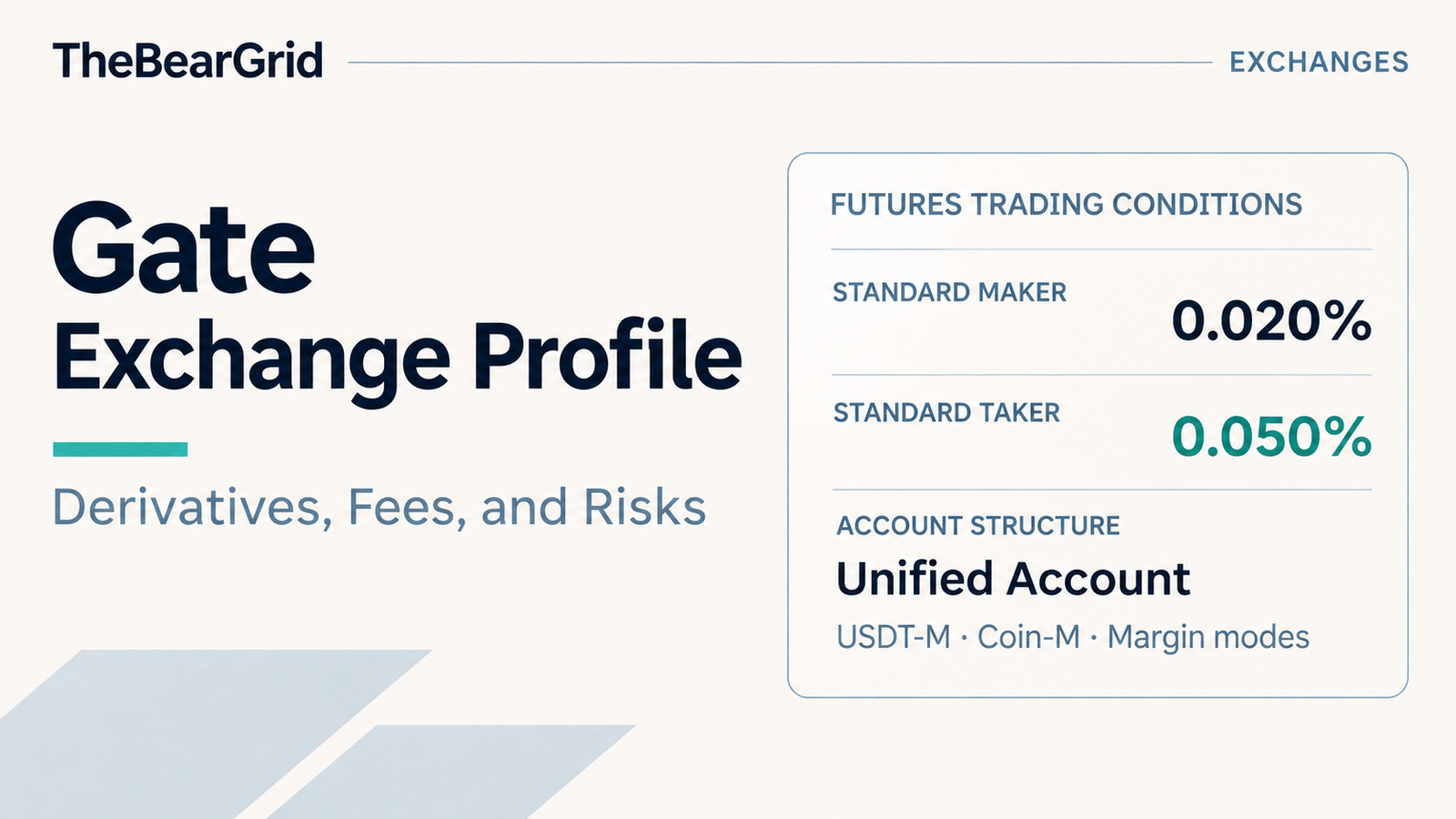
Gate offers a broad range of cryptocurrency derivatives, including USDT-margined and coin-margined perpetual futures.
For traders comparing futures exchanges, however, contract availability is only one part of the decision. Trading fees, collateral efficiency, liquidation rules, and execution quality can have a greater impact on actual trading results.
Gate also operates a Unified Account system with multiple margin configurations, allowing eligible traders to manage exposure across different products and collateral assets.
This profile examines Gate’s futures trading structure using official exchange documentation, focusing on the costs, margin mechanisms, and risks that matter when evaluating a derivatives trading venue.
The analysis is based on publicly available information rather than independent live execution testing.
Table of Contents
1. Gate Futures Products and Contract Structure
Gate provides several derivatives products, with USDT-margined (USDT-M) and coin-margined (Coin-M) perpetual futures representing two important contract structures.
Both allow long and short positions without a fixed expiration date, but they differ in collateral, settlement currency, and exposure.
| Feature | USDT-M Perpetuals | Coin-M Perpetuals |
|---|---|---|
| Margin asset | USDT | Relevant cryptocurrency |
| Settlement currency | USDT | Cryptocurrency |
| Contract structure | Linear | Typically inverse |
| Profit and loss | Stablecoin-denominated | Coin-denominated |
| Key consideration | Stablecoin-based collateral | Changing collateral value |
For traders who measure performance in USDT, USDT-M contracts provide a relatively straightforward way to track position value and trading results.
Coin-M contracts introduce additional collateral exposure.
For example, a trader holding a BTC-margined long position during a sharp Bitcoin decline may experience both trading losses and a reduction in the dollar value of the BTC used as collateral.
This does not mean Coin-M contracts are inherently less suitable. Their usefulness depends on the trader’s collateral holdings, market exposure, and objectives.
See our detailed explanation of USDT-Margined vs Coin-Margined Perpetuals.
Contract Availability vs Trading Quality
Gate offers perpetual markets beyond Bitcoin and Ethereum, including numerous altcoin contracts.
A wide selection may be useful for traders seeking exposure to smaller markets, but listing availability does not establish execution quality.
Smaller contracts may have thinner order books, wider spreads, or greater slippage than major perpetual markets.
Traders should therefore evaluate each contract’s trading conditions individually rather than treating the exchange’s overall market selection as a measure of liquidity.
2. Gate Trading Fees and Execution Costs
Gate applies a maker/taker fee structure to its perpetual futures markets.
Following its September 1, 2026 fee update, Gate’s published standard rates for VIP 0 users trading regular USDT-M perpetual futures are:
| Fee Type | VIP 0 Base Rate |
|---|---|
| Maker | 0.0200% |
| Taker | 0.0500% |
Maker orders provide liquidity by resting on the order book before execution.
Taker orders remove existing liquidity when they execute immediately against available orders.
A limit order does not necessarily qualify for maker fees. If it executes immediately, the filled quantity may be charged at the taker rate.
These rates are reference fees, not guaranteed account-specific charges.
Actual fees may differ according to VIP status, contract category, promotional arrangements, and applicable trading-fee benefits.
Gate also operates separate fee arrangements for certain derivatives products, including TradFi perpetual futures.
Trading Cost Example: $20,000 Position
Consider a trader opening and closing a $20,000 USDT-M perpetual position.
Assume the position has the same notional value at entry and exit, and the standard VIP 0 rates apply without additional discounts.
| Execution | Entry Fee | Exit Fee | Total Fee |
|---|---|---|---|
| Maker / Maker | $4 | $4 | $8 |
| Maker / Taker | $4 | $10 | $14 |
| Taker / Taker | $10 | $10 | $20 |
Under these assumptions, a complete maker/maker trade costs $8, compared with $20 for taker/taker execution.
For a trader completing 30 similar round trips, the total trading fees would be $240 and $600, respectively.
The difference illustrates why execution style can materially affect trading costs over time.
Trading fees are primarily determined by position notional and applicable fee rates, rather than the amount of initial margin alone.
Increasing leverage while keeping the same position notional does not directly increase the trading commission. Using leverage to open a larger position, however, increases the absolute fee amount.
Funding payments, slippage, and potential liquidation-related costs are additional considerations.
See Crypto Futures Trading Fees for a broader explanation.
3. Gate Unified Account and Margin Modes
One of Gate’s important structural features is its Unified Account system.
Rather than relying exclusively on separate balances for every trading product, Gate offers different account configurations that can support shared margin and collateral management.
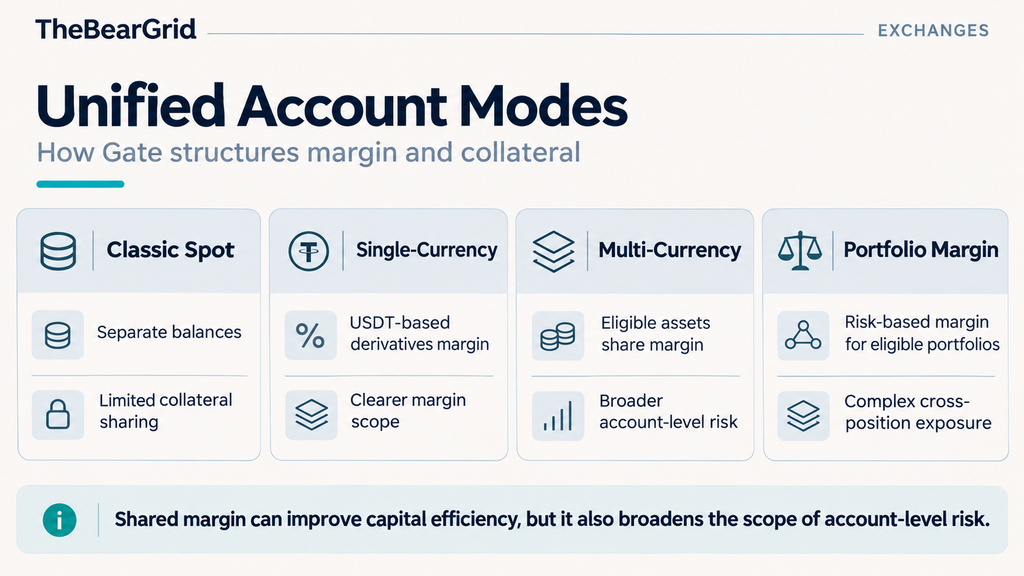
The system includes four account modes.
| Account Mode | Main Characteristic | Risk Consideration |
|---|---|---|
| Classic Spot | Separate trading-product balances | Limited collateral sharing |
| Single-Currency Margin | USDT-based derivatives margin | USDT margin exposure |
| Multi-Currency Margin | Multiple eligible collateral assets | Shared account-level risk |
| Portfolio Margin | Risk-based margin for eligible hedged portfolios | Complex cross-position exposure |
Single-Currency Margin
Single-Currency Margin uses USDT as the primary derivatives collateral.
This structure can be more straightforward for traders who prefer to manage futures exposure without using several cryptocurrencies as shared margin.
It also provides clearer separation between USDT derivatives collateral and unrelated spot assets.
Multi-Currency Margin
Multi-Currency Margin allows eligible assets to contribute to a shared margin balance.
This can improve capital efficiency by reducing the need to move collateral manually between different trading activities.
However, it also changes the risk structure.
When several assets support the same account, losses from one position may affect the available margin supporting others.
The value of non-USDT collateral may also fluctuate independently of the position being traded.
Portfolio Margin
Portfolio Margin is designed for eligible traders managing more complex positions.
Instead of evaluating every position purely in isolation, the system considers defined risk exposures and eligible offsets within the portfolio.
This can reduce margin requirements for certain hedged strategies.
However, lower margin requirements do not eliminate market risk. Changes in correlations, collateral values, or portfolio composition may increase margin pressure.
Portfolio Margin is therefore better understood as an advanced collateral-management framework rather than a simple way to obtain higher leverage.
The key trade-off across Gate’s account modes is capital efficiency versus the scope of assets exposed to shared margin risk.
Availability, eligibility thresholds, supported products, and risk calculations should be checked against Gate’s current account documentation.
4. Mark Price, Liquidation and Risk Management
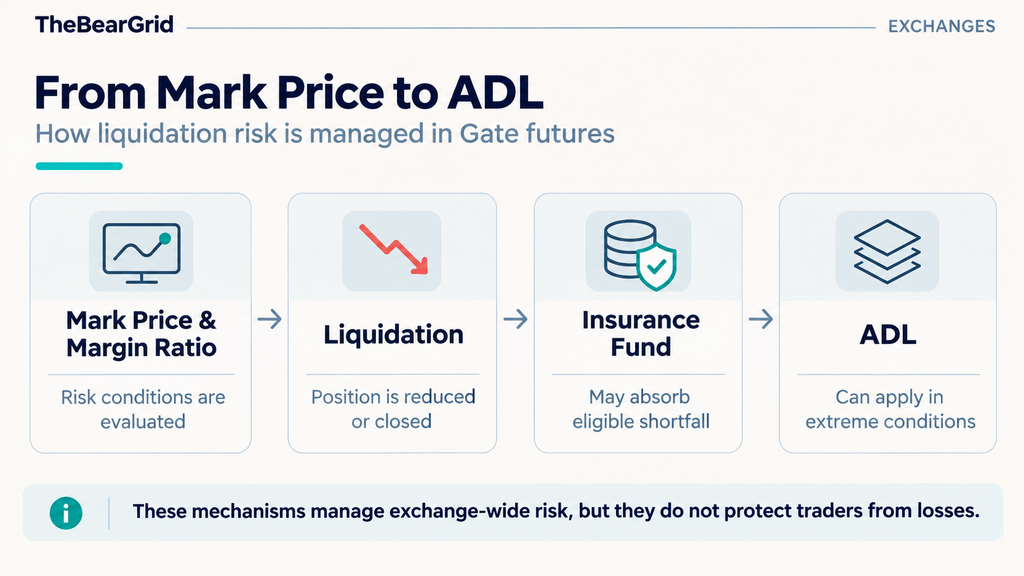
Gate’s futures risk-management structure includes mark-price valuation, maintenance margin requirements, position risk limits, insurance-fund arrangements, and auto-deleveraging.
These mechanisms affect what happens when leveraged positions experience adverse market movements.
Mark Price and Liquidation
Gate uses Mark Price rather than relying solely on the latest traded price when determining liquidation conditions.
The objective is to reduce the influence of isolated trades or temporary price distortions that may not reflect broader market conditions.
However, Mark Price does not protect traders from genuine market losses.
Liquidation risk depends on the available margin relative to the applicable maintenance margin requirements.
These requirements can vary with contract specifications, account mode, and position size.
Margin and Leverage Example
Consider a $20,000 perpetual position opened with 10x leverage.
Ignoring fees and additional requirements, the initial position margin would be approximately $2,000.
If the position moves 5% against the trader, the unrealized loss would be approximately $1,000.
That represents 50% of the initial margin, even though the underlying market moved only 5%.
Actual liquidation may occur before the full initial margin is exhausted because exchanges require maintenance margin and may account for additional costs.
For traders using shared margin, the consequences can extend beyond a single isolated position.
See Cross Margin vs Isolated Margin for a more detailed explanation.
Insurance Fund and Auto-Deleveraging
Gate operates an insurance fund as part of its derivatives liquidation framework.
When a liquidated position cannot be closed without a shortfall, the insurance fund may absorb eligible losses according to the exchange’s rules.
Under extreme market conditions, if the available mechanisms cannot absorb the remaining exposure, Auto-Deleveraging (ADL) may be triggered.
ADL can reduce positions held by other market participants, including profitable opposing positions.
These mechanisms help manage systemic liquidation exposure but do not guarantee that individual traders will avoid losses.
Traders should verify Gate’s current regional restrictions and product availability before using the platform.
5. Funding Rates and Settlement Rules
Like other perpetual futures exchanges, Gate uses funding payments as part of the mechanism that helps keep perpetual contract prices aligned with their underlying reference markets.
Funding payments are separate from ordinary trading commissions.
When the funding rate is positive, long positions generally pay short positions. When it is negative, short positions generally pay long positions.
For example, consider a $20,000 USDT-margined perpetual position with a positive funding rate of 0.01%.
The funding payment would be approximately $2 for that settlement event, assuming an unchanged position notional.
A trader holding the same position through several funding events may experience cumulative costs or receipts.
Gate’s funding intervals and calculation parameters can differ by contract and may be adjusted.
For this reason, traders should check the actual funding schedule and rate displayed for the relevant contract rather than assuming that every perpetual settles on an identical timetable.
Funding also provides information about market positioning, but an elevated rate alone does not establish whether a trade is attractive.
Related reading: How Funding Rates Reflect Positioning and Market Stress.
6. Liquidity, Order Execution and Market Conditions
Gate’s broad contract selection gives traders access to different derivatives markets, but execution conditions can vary considerably.
Trading volume alone is not sufficient to evaluate liquidity.
For futures traders, three factors are particularly important.
Order-book depth: The amount of executable liquidity available around the current price.
Bid-ask spread: The difference between the best bid and ask prices.
Slippage: The difference between the expected execution price and the actual average fill price.
A contract with a low published trading fee can still be expensive to trade if the spread is wide or the order book cannot absorb the intended position size.
This distinction becomes more important during periods of rapid price movement, when liquidity may deteriorate.
Gate also provides contract-level market information such as recent trading activity and open interest.
These indicators offer useful context, but they should not be treated as direct substitutes for an order-book or execution-quality assessment.
TheBearGrid has not independently measured Gate’s live order-book depth or execution performance for this profile.
As a result, the analysis does not claim that Gate offers better or worse liquidity than Binance, OKX, Bybit, or another exchange.
See Crypto Exchange Volume vs Liquidity for an explanation of why reported volume and actual execution quality can differ.
Conclusion
Gate provides a broad perpetual futures offering supported by multiple contract structures, maker/taker trading fees, and a Unified Account system with several margin configurations.
Its main practical consideration is not simply the number of available contracts, but how traders manage collateral and execution costs across different markets.
USDT-M and Coin-M contracts introduce different collateral exposures, while Unified Account modes offer varying degrees of capital efficiency and shared risk.
Gate’s published VIP 0 fees also provide a clear starting point for estimating trading costs, although actual charges depend on contract type, execution method, and account-specific benefits.
For traders evaluating Gate against other derivatives venues, the most useful approach is to compare contract-level liquidity, fee conditions, margin structure, funding arrangements, and liquidation rules together.
Explore Gate — 20% Trading Fee Benefit
Gate offers a range of perpetual futures markets with different contract structures, margin options, and trading conditions.
Readers interested in exploring Gate may be eligible for a 20% trading-fee discount through TheBearGrid’s partner link.
Explore Gate — TheBearGrid Partner Offer
Before registering or trading, verify the applicable fee reduction, eligible products, account requirements, and regional availability. The benefit is subject to Gate’s current partner terms.
Affiliate Disclosure: TheBearGrid is a Gate affiliate partner and may earn commissions from qualifying activity through this link. This relationship does not influence our independent research, exchange assessments, or risk analysis.
Methodology
This profile is based primarily on official Gate documentation and exchange announcements reviewed on November 20, 2026.
The analysis covers publicly documented contract structures, base trading fees, Unified Account configurations, funding mechanisms, and liquidation procedures.
Fee calculations use the published VIP 0 USDT-M reference schedule and explicitly stated assumptions.
No live execution testing, independent order-book measurement, or verification of individual affiliate-discount eligibility was conducted.
The analysis does not constitute a comparative exchange ranking.
References
- Gate — USDT-M Perpetual Futures Fee Updates
- Gate — Differences Between Margin Modes in Unified Account
- Gate — Perpetual Futures Overview
- Gate — Liquidation Mechanism
- Gate — Insurance Fund
- Gate — Futures Fees and Funding Rates Explained
Editorial Independence
TheBearGrid maintains editorial independence in its exchange research.
Affiliate partnerships do not determine an exchange’s assessment, risk discussion, or placement in comparative research.
The existence of a referral arrangement does not imply that Gate is the most suitable exchange for any particular trader.
Disclaimer
This article is for educational and informational purposes only and does not constitute investment advice.
Cryptocurrency derivatives involve significant risks, including leverage-related losses, liquidation, exchange operational risk, and potential loss of collateral.
Fees, contract terms, eligibility, and available services may change. Readers should independently verify current information before making trading decisions.