Bybit offers a range of cryptocurrency derivatives products, including USDT-margined, USDC-margined, and inverse futures contracts. Its Unified Trading Account (UTA) also allows eligible traders to manage different trading products and collateral assets within a shared account structure.
For traders comparing cryptocurrency exchanges, these features create several ways to manage leveraged exposure. However, the availability of multiple contract types and margin configurations does not necessarily translate into lower trading costs or better risk management.
The actual trading experience depends on the contract being traded, the account’s fee tier, available market liquidity, funding payments, and the way collateral is allocated across positions.
Bybit’s margin architecture introduces another important consideration. Under its Unified Trading Account, the selected margin mode applies across the account rather than being configured independently for every trading pair. This can simplify collateral management, but it also affects how risks are shared between positions.
This profile examines Bybit’s derivatives products, trading fees, margin system, and liquidation mechanisms using official exchange documentation. The analysis focuses on the conditions that matter when evaluating a derivatives trading venue rather than relying on advertised features alone.
It does not represent hands-on trading tests, independently measured execution quality, or an endorsement of Bybit.
Table of Contents
1. Bybit Derivatives: Contract Types and Settlement
Bybit’s core cryptocurrency derivatives offering includes USDT perpetual and expiry contracts, USDC perpetual contracts, and inverse perpetual and expiry contracts.
These products provide exposure to cryptocurrency price movements, but their margin and settlement arrangements differ.
Understanding those differences is particularly important when using leverage, because the denomination of collateral and profit or loss influences the position’s overall risk.
USDT-Margined Futures
USDT-margined contracts are generally linear derivatives settled in USDT.
For example, a BTCUSDT perpetual contract allows a trader to establish a Bitcoin price exposure while calculating trading profit and loss in USDT.
This structure provides a relatively straightforward way to evaluate the financial result of a position in stablecoin terms.
A trader holding a fixed quantity of BTC exposure generally experiences a proportional change in the position’s USDT-denominated profit or loss when the underlying price changes.
However, USDT settlement does not eliminate collateral risk. Traders remain exposed to the value, liquidity, and operational characteristics of the settlement asset.
USDC-Margined Futures
Bybit also offers USDC-margined perpetual contracts.
These contracts provide linear exposure with settlement denominated in USDC rather than USDT.
Although the general trading mechanics are similar, the exact contract specifications, available markets, and account rules may differ.
Traders should not assume that a BTCUSDT and BTCUSDC contract have identical liquidity, funding conditions, or settlement arrangements simply because they reference the same underlying cryptocurrency.
The relevant contract documentation should be reviewed before treating them as interchangeable products.
Inverse Futures
Inverse futures are quoted in a reference currency such as USD but settled in cryptocurrency.
A BTCUSD inverse contract, for example, generally uses BTC as its settlement asset.
Unlike a linear USDT contract, the amount of BTC profit or loss depends on the inverse contract’s specific calculation.
This creates an additional consideration for traders whose collateral is denominated in Bitcoin.
The dollar value of their collateral may fluctuate at the same time as the derivatives position generates gains or losses.
For a leveraged long position, a decline in Bitcoin’s price can reduce both the value of the underlying exposure and the dollar value of the BTC used as collateral.
The exact financial impact depends on the contract structure, position direction, and margin mode.
Comparing Bybit’s Main Futures Contracts
| Feature | USDT Perpetual | USDC Perpetual | Inverse Perpetual |
|---|---|---|---|
| Settlement asset | USDT | USDC | Cryptocurrency |
| Contract structure | Linear | Linear | Inverse |
| Profit and loss | USDT-denominated | USDC-denominated | Crypto-denominated |
| Main collateral consideration | Stablecoin and margin risk | Stablecoin and margin risk | Crypto collateral price risk |
| Funding payments | Yes | Yes | Yes |
| Scheduled expiration | No | No | No |
Bybit also supports expiry futures and options for eligible markets and accounts.
Expiry futures settle according to defined expiration rules, while perpetual contracts use recurring funding payments rather than a scheduled expiration date.
These distinctions matter because trading fees, funding arrangements, margin requirements, and settlement conditions must be evaluated at the contract level.
For a general explanation of perpetual futures mechanics, see What Are Perpetual Futures?.
2. Bybit Trading Fees and the Real Cost of a Position
Bybit applies a maker-taker fee structure to its derivatives markets.
Maker orders add liquidity to the order book, while taker orders remove existing liquidity.
The fee charged to a trader depends on the relevant product, account level, jurisdiction, and applicable fee arrangements.
Maker and Taker Fee Structure
Bybit’s published trading fee schedule lists the following base rates for VIP 0 accounts trading perpetual and futures contracts:
| Fee Type | Published VIP 0 Base Rate |
|---|---|
| Maker | 0.0200% |
| Taker | 0.0550% |
These are published base rates, not guaranteed account-specific quotations.
Bybit explicitly notes that actual trading fees can vary by region. Traders should therefore consult the account’s My Fee Rate page after completing the applicable identity verification process.
Higher VIP tiers may qualify for lower commissions, subject to the exchange’s eligibility requirements.
Source: Bybit — Trading Fee Structure.
What a $20,000 Futures Trade Costs
Consider a hypothetical trader opening and later closing a BTCUSDT perpetual position.
Assume the following:
| Variable | Assumption |
|---|---|
| Position notional | $20,000 |
| Initial margin | $2,000 |
| Leverage | 10× |
| Maker fee | 0.0200% |
| Taker fee | 0.0550% |
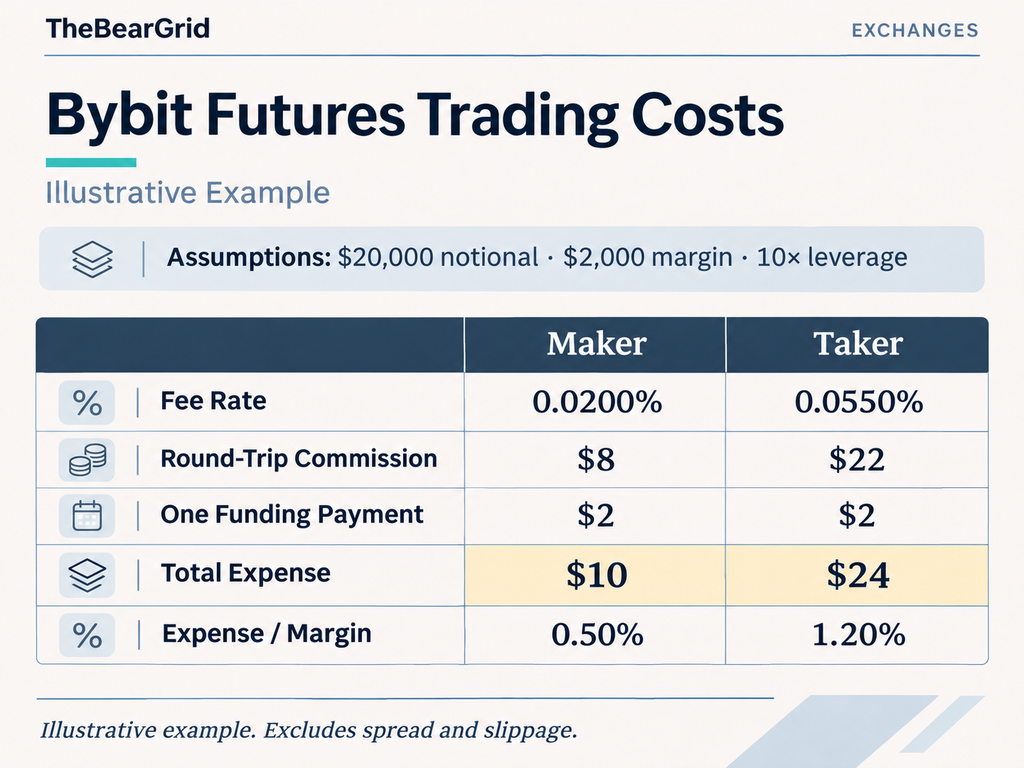
The calculations use Bybit’s published VIP 0 base rates, assuming they apply to the hypothetical account and contract.
Both entry and exit notional values are assumed to remain at $20,000.
Taker Entry and Exit
If the trader opens and closes the position through taker orders:
- Opening commission: $20,000 × 0.00055 = $11
- Closing commission: $20,000 × 0.00055 = $11
- Total commission: $22
The $22 commission represents 0.11% of the position’s notional value.
However, relative to the $2,000 initial margin, it represents 1.10%.
This distinction matters when evaluating leveraged trading performance.
The published fee rate is small relative to the position notional, but its impact on committed capital is larger.
Maker Entry and Exit
Now assume both transactions successfully execute as maker orders.
- Opening commission: $20,000 × 0.0002 = $4
- Closing commission: $20,000 × 0.0002 = $4
- Total commission: $8
The maker scenario saves $14 in explicit commissions.
However, this does not establish that maker orders always produce better trading outcomes.
A resting limit order may remain unfilled. A trader waiting for execution can also experience unfavorable market movements or miss an intended entry or exit.
The actual result depends on execution prices and market conditions, not only the commission classification.
Trading Fees vs. Order Cost
Bybit uses the term Order Cost to describe the funds required when placing certain derivatives orders.
Its official documentation explains that order cost can include the initial margin, the estimated opening fee, and a reserve for the expected closing fee.
This distinction is important.
The inclusion of an estimated closing fee in the order cost does not mean the exchange has necessarily charged both trading commissions at the moment the position is opened.
Actual trading commissions are associated with executed transactions, while the order-cost calculation accounts for funds that may be required to support the order and its eventual closing.
This can help explain why the amount shown as required for an order may exceed the simple calculation of notional value divided by leverage.
Source: Bybit — Order Cost (Perpetual and Expiry Contracts).
Why Trading Fees Are Not the Total Cost
The previous calculations exclude several expenses that can affect a completed trade.
A market order may execute at a price worse than the reference mid-price, particularly when order book depth is limited.
A position held through a funding settlement may also incur a funding payment.
Depending on the account configuration, borrowing-related charges or other applicable costs may arise.
Therefore, the actual result must consider execution prices, commissions, funding payments, and other relevant account charges.
For a detailed breakdown of these costs, see Crypto Perpetual Futures Trading Fees Explained.
3. Bybit Unified Trading Account: Three Margin Modes
One of Bybit’s defining derivatives features is the Unified Trading Account.
UTA combines access to eligible spot, derivatives, and options trading within a common trading-account architecture.
It can also allow eligible collateral assets and unrealized gains to support exposures across different products.
However, the degree of collateral sharing depends on the selected margin mode.
Bybit supports three main UTA margin modes: Isolated Margin, Cross Margin, and Portfolio Margin.
An important operational detail is that the selected UTA margin mode applies at the account level. Traders cannot independently assign a different UTA margin mode to every trading pair within the same account.
Isolated Margin
Isolated Margin allocates collateral to individual derivatives positions.
Each position is primarily supported by its assigned margin, allowing its risk to be managed more separately from other positions.
This can be useful for traders who want to limit the amount of collateral directly committed to a specific trade.
However, isolated margin does not eliminate liquidation risk or guarantee that the initially allocated margin will remain unchanged.
Bybit supports Auto Margin Replenishment for eligible isolated-margin arrangements. When enabled, this mechanism can transfer available funds to a position approaching its liquidation threshold.
The feature can help maintain a position, but it also increases the amount of capital exposed to that trade.
Traders should therefore distinguish between their original margin allocation and the total collateral that may ultimately be committed.
Cross Margin
Cross Margin is the default margin mode described in Bybit’s UTA documentation.
Under this arrangement, eligible collateral can support multiple positions within the account’s applicable margin framework.
Unrealized profits and losses may contribute to account-level margin calculations, allowing gains on one position to help offset losses on another.
This can improve capital efficiency, particularly for traders managing multiple derivatives exposures.
However, it also makes risks more interconnected.
A losing position can reduce the shared margin balance available to support other positions.
The account may also recognize some assets at discounted collateral values rather than their full market prices.
As a result, the amount of available margin can change even when the nominal quantity of collateral remains unchanged.
Portfolio Margin
Portfolio Margin evaluates risk using a broader assessment of eligible combined exposures.
Instead of applying the same margin treatment to every position independently, the system can recognize certain relationships between positions that offset risk.
For example, eligible positions with opposing sensitivities may require less combined margin than two unrelated directional positions.
However, these offsets depend on Bybit’s risk methodology, product eligibility, and account conditions.
A portfolio that appears hedged under ordinary conditions may still experience losses when correlations or price relationships change.
Portfolio Margin also involves more complex calculations and specific account eligibility requirements.
It should not be interpreted as a universally lower-risk alternative to Cross Margin.
Comparing UTA Margin Modes
| Feature | Isolated Margin | Cross Margin | Portfolio Margin |
|---|---|---|---|
| Margin allocation | Primarily position-specific | Shared eligible collateral | Portfolio-level risk assessment |
| P&L offsets | No account-wide derivatives offset | Eligible P&L offsets | Eligible risk offsets |
| Borrowing support | No | Yes, under applicable rules | Yes, under applicable rules |
| Auto Margin Replenishment | Available | Not applicable | Not applicable |
| Main consideration | Position-level collateral exposure | Shared account risk | Complex risk model and offsets |
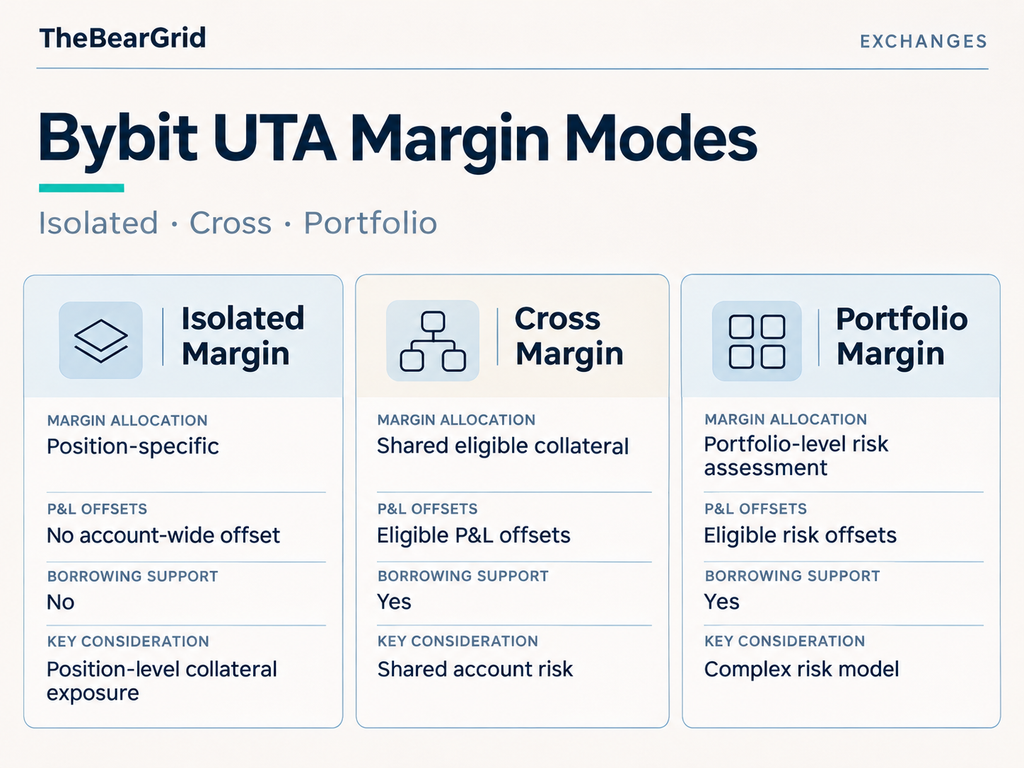
Features and eligibility depend on the relevant account and product rules.
A trader selecting a UTA margin mode is therefore making an account-level risk-management decision, not simply choosing how much leverage to apply to an individual position.
Source: Bybit — Differences Between the Margin Modes Under the Unified Trading Account.
Collateral Value Ratios
Bybit may apply collateral value ratios to supported assets used as margin.
For example, suppose a trader holds a cryptocurrency asset worth $10,000 at current market prices.
If the applicable collateral value ratio is hypothetically 90%, the recognized collateral contribution would be:
$10,000 × 90% = $9,000
The trader still holds an asset with a market value of $10,000, but only $9,000 is recognized for the relevant collateral calculation.
This is an illustrative example, not a statement of the current collateral ratio for any specific cryptocurrency.
Actual ratios depend on the asset, applicable value tiers, and Bybit’s current collateral rules.
Such discounts are important because the account’s recognized collateral balance can differ from the market value of the assets held.
For a trader using Cross or Portfolio Margin, changes in collateral prices and valuation ratios can influence available margin across multiple positions.
Source: Bybit — Understanding Collateral Value Ratios in Unified Trading Account.
4. Mark Price, Maintenance Margin, and Liquidation
Liquidation risk on Bybit depends on more than the leverage displayed when a position is opened.
The relevant margin mode, position exposure, collateral value, unrealized profit and loss, and maintenance margin requirements all influence the risk of forced position reduction.
Bybit uses Mark Price rather than Last Traded Price as a key reference for derivatives liquidation.
Why Mark Price Matters
Last Traded Price represents the price of the most recent transaction.
Mark Price is a reference value used in calculations such as unrealized profit and loss and liquidation conditions.
The purpose of using a reference-price methodology is to reduce the effect of isolated price movements that may not represent broader market conditions.
However, Mark Price does not prevent liquidation during sustained adverse market movements.
A position can still be liquidated when its relevant margin conditions are no longer satisfied.
Bybit’s 2025 Margin Calculation Update
A notable development in Bybit’s derivatives risk framework was its September 2025 update to margin calculations for perpetual and expiry contracts.
The change introduced greater use of Mark Price in the calculation of Initial Margin and Maintenance Margin.
According to Bybit’s official documentation:
| Margin Mode | Initial Margin Calculation | Maintenance Margin Calculation |
|---|---|---|
| Isolated | Entry-price-based for the relevant linear contracts | Mark-price-based |
| Cross | Mark-price-based | Mark-price-based |
| Portfolio | Existing portfolio risk methodology | Existing portfolio risk methodology |
Simplified overview of the documented update. Actual calculations include contract-specific terms, fee components, and other adjustments.
The changes matter because reference-price movements can affect required margin in ways that are not captured by a static calculation using the original entry price.
For Cross Margin, changes in Mark Price can influence the account’s required margin as well as its unrealized profit and loss.
This makes the relationship between market prices, account equity, and maintenance margin particularly important.
Source: Bybit — The New Margin Calculation: Adjustments and Implications.
Liquidation Under Different Margin Modes
Under Isolated Margin, Bybit describes liquidation as occurring when the position’s Mark Price reaches the applicable liquidation price.
Cross Margin and Portfolio Margin use broader account-level risk calculations.
For these modes, the Maintenance Margin Rate is a key indicator. Under the documented UTA framework, an MMR of 100% or higher indicates that the account has reached the relevant liquidation condition.
The exact liquidation process depends on the account mode, contract, position configuration, and applicable risk rules.
Open orders may be canceled, positions may be reduced, and further liquidation procedures may follow according to the exchange’s rules.
An estimated liquidation price should not be treated as a permanent threshold. Collateral changes, funding payments, position adjustments, and other account activity can alter the position’s risk.
Source: Bybit — Trading Rules: Liquidation Process (Unified Trading Account).
Why Account-Level Risk Deserves Attention
Suppose a trader holds two leveraged positions under Cross Margin.
If one position experiences a significant loss, the shared margin balance can decline even when the second position remains profitable.
Similarly, a sharp decline in the value of eligible cryptocurrency collateral may reduce the margin available to support both positions.
The risk is not limited to the price movement of one contract.
It also depends on how the account combines assets, liabilities, and derivatives exposures.
This is why the choice between Isolated, Cross, and Portfolio Margin is a central part of evaluating Bybit’s trading conditions.
For a broader explanation, see How Crypto Futures Liquidation Works.
5. Funding Rates, Insurance Funds, and Auto-Deleveraging
Perpetual futures introduce costs and risks beyond the trading commission and initial margin requirement.
Three mechanisms are particularly important: funding payments, insurance funds, and Auto-Deleveraging.
Funding Rates
Bybit uses funding payments to help keep perpetual futures prices aligned with their underlying reference markets.
When funding is positive, long positions generally pay short positions.
When funding is negative, short positions generally pay long positions.
The payment is calculated using the relevant position value and funding rate at settlement.
For a standard linear perpetual contract:
Funding Fee = Position Value × Funding Rate
Consider a $20,000 long position held through one settlement at a hypothetical positive funding rate of 0.01%.
The funding payment would be:
$20,000 × 0.0001 = $2
Adding this payment to the previous trading-fee example produces:
| Cost Component | Taker Entry & Exit | Maker Entry & Exit |
|---|---|---|
| Trading commissions | $22 | $8 |
| One funding payment | $2 | $2 |
| Combined expense | $24 | $10 |
| Expense / $2,000 margin | 1.20% | 0.50% |
Illustrative calculation. Assumes unchanged entry and exit notional values, identical settlement values, and no additional spread or slippage costs.
The funding payment is not an ordinary trading commission collected by the exchange.
It is generally transferred between traders holding opposing positions.
Bybit also notes that funding intervals and limits can differ by contract.
Importantly, when a contract’s funding rate reaches a specified upper or lower limit at settlement, Bybit may automatically shift its settlement frequency to once per hour under the documented rules.
This means the displayed funding rate and settlement schedule should be evaluated together.
Source: Bybit — Funding Fee Calculation.
For more on perpetual funding mechanics, see Crypto Funding Rate Explained.
Insurance Funds
Bybit maintains insurance funds to address certain shortfalls arising from liquidated futures positions.
When a liquidated position is closed at a price worse than its bankruptcy price, the resulting shortfall may be covered by the relevant insurance fund.
Conversely, when liquidation execution produces a surplus relative to the bankruptcy price under applicable rules, the surplus may contribute to the fund.
This mechanism is designed to reduce the likelihood that one trader’s bankrupt position creates losses beyond the normal liquidation process.
However, insurance funds are not a guarantee against trading losses.
They do not protect traders from ordinary liquidation or ensure the return of posted collateral.
Source: Bybit — Insurance Fund.
Auto-Deleveraging
Auto-Deleveraging, or ADL, is another mechanism used under extreme market conditions.
If a bankrupt liquidated position cannot be adequately resolved through the normal liquidation process and available insurance fund resources, Bybit may automatically reduce selected opposing positions.
The priority system considers factors including position profitability and effective leverage, with calculations depending on the applicable margin mode.
This introduces a distinct risk for profitable traders.
A position can be reduced through ADL even when its own collateral remains sufficient.
Bybit provides an ADL ranking indicator to help traders understand their relative exposure to this mechanism.
The exchange also documents certain account-level features intended to change ADL ranking for eligible hedged positions, but these protections are conditional and do not eliminate all ADL risk.
Source: Bybit — Introduction to Delta Neutral Mode.
What These Mechanisms Reveal
Funding, insurance funds, and ADL serve different purposes.
Funding influences the economics of holding perpetual futures exposure.
Insurance funds address certain losses associated with bankrupt liquidations.
ADL provides a further mechanism for resolving exceptional losses that cannot be absorbed through ordinary procedures.
The existence of these mechanisms does not establish that an exchange is free from counterparty or systemic risk.
A meaningful assessment considers their scope, limitations, and potential effects on both losing and profitable positions.
6. Order Execution, Liquidity, and Trading Conditions
Trading fees are only one part of a futures exchange’s execution economics.
A market with relatively low commissions may still generate higher trading costs if its order book has wide spreads or limited depth.
Bybit supports several order types that allow traders to manage execution timing, price limits, and position exposure.
Order Types and Execution Trade-Offs
| Order Type | Main Function | Key Trade-Off |
|---|---|---|
| Market | Executes against available liquidity | Final execution price may differ from expectations |
| Limit | Restricts the execution price | May remain partially or fully unfilled |
| Post-Only | Prevents immediate taker execution | Order can be canceled without a fill |
| Immediate-or-Cancel | Executes available quantity immediately | Unfilled quantity is canceled |
| Fill-or-Kill | Requires full immediate execution | Entire order is canceled if it cannot fill |
| Reduce-Only | Prevents an order from increasing a position | Cannot be used to add exposure |
Bybit also supports additional execution features, including conditional orders and selected algorithmic order types.
These features can help traders control execution behavior, but their existence does not guarantee lower trading costs.
Source: Bybit — Types of Orders Available on Bybit.
Why Liquidity Must Be Measured by Contract
A major BTC perpetual contract and a smaller altcoin perpetual contract can have very different liquidity conditions.
The relevant considerations include bid-ask spreads, available order book depth, and expected slippage for the intended order size.
A trader opening a small position may experience relatively limited market impact, while a larger order may need to execute across several price levels.
Liquidity can also change during periods of volatility, concentrated liquidations, or shifts in market-maker participation.
Therefore, exchange-wide trading volume should not be treated as a direct measurement of execution quality for every listed derivatives product.
Does This Profile Verify Bybit’s Execution Quality?
No.
This analysis does not include independently captured order book snapshots, controlled trading tests, or comparable slippage measurements across exchanges.
It does not claim that Bybit provides better or worse execution than Binance, OKX, or another derivatives venue.
A valid comparison would require matched contracts, identical order sizes, consistent observation periods, and a clearly defined reference-price methodology.
For a detailed explanation, see Why Crypto Exchange Trading Volume Doesn’t Equal Liquidity.
Conclusion
Bybit provides a derivatives trading structure built around multiple futures contract types, maker-taker trading fees, and a Unified Trading Account with different margin configurations.
Its USDT, USDC, and inverse contracts offer different approaches to collateral and settlement. Trading commissions, execution prices, and funding payments influence the cost of establishing and maintaining positions.
One of the most important considerations is the account-level nature of Bybit’s margin system.
Isolated Margin provides more separation between positions, while Cross Margin allows eligible collateral and unrealized profit or loss to contribute to shared account exposure. Portfolio Margin introduces a more complex framework for recognizing risk offsets.
These arrangements can improve capital efficiency, but they also affect how losses and collateral changes are transmitted across positions.
Bybit’s Mark Price-based margin calculations, insurance funds, and ADL procedures further demonstrate why a derivatives exchange should be evaluated through its operational risk framework rather than advertised leverage alone.
The availability of these features does not automatically make Bybit the most suitable venue for every trader.
A meaningful evaluation must consider the intended contract, applicable trading fees, order size, margin mode, funding conditions, and execution quality.
The key question is not simply what Bybit offers, but how its trading costs and account-level risk rules affect the specific exposure a trader intends to hold.
That distinction provides a more consistent basis for comparing Bybit with other cryptocurrency derivatives exchanges.
Related Research
- Binance Exchange Profile: Derivatives, Fees, and Risks — Binance futures contracts, trading commissions, collateral, and risk mechanisms.
- OKX Exchange Profile: Derivatives, Fees, and Risks — OKX derivatives products, unified account modes, and funding methodology.
- Crypto Perpetual Futures Trading Fees Explained — Maker-taker commissions, spreads, slippage, funding, and leverage costs.
- How Crypto Futures Liquidation Works — Mark Price, maintenance margin, liquidation, and ADL.
- Crypto Funding Rate Explained — How funding payments work in perpetual futures.
- Why Crypto Exchange Trading Volume Doesn’t Equal Liquidity — Why reported volume alone cannot establish execution quality.
References
- Bybit — FAQ: Unified Trading Account. Supported products and UTA architecture.
- Bybit — Trading Fee Structure. Published VIP 0 and higher-tier maker-taker fee rates.
- Bybit — Order Cost (Perpetual and Expiry Contracts). Initial margin, opening fees, and estimated closing-fee requirements.
- Bybit — Differences Between the Margin Modes Under the Unified Trading Account. Account-level margin configurations and risk differences.
- Bybit — Understanding Collateral Value Ratios in Unified Trading Account. Collateral eligibility and valuation discounts.
- Bybit — The New Margin Calculation: Adjustments and Implications. The September 2025 shift toward Mark Price-based margin requirements.
- Bybit — Trading Rules: Liquidation Process (Unified Trading Account). Liquidation mechanics across margin modes.
- Bybit — Funding Fee Calculation. Funding payments, settlement intervals, and contract-specific calculations.
- Bybit — Insurance Fund. Treatment of liquidation shortfalls and insurance fund balances.
- Bybit — Introduction to Delta Neutral Mode. Conditional changes to ADL ranking for eligible positions.
- Bybit — Types of Orders Available on Bybit. Market, limit, Post-Only, and other order instructions.
Source review date: November 4, 2026. This article is based on publicly available Bybit documentation rather than first-hand trading tests, independent execution measurements, or audited exchange performance data. Trading examples are illustrative, and applicable account-level fees may differ from the published base rates. Contract specifications, fees, margin requirements, and product availability can change.
Editorial independence: This profile does not constitute an endorsement or ranking of Bybit. Any future commercial relationship or affiliate link should be disclosed separately.
Disclaimer: This article is intended for educational and informational purposes only and does not constitute financial, investment, or legal advice. Cryptocurrency derivatives involve substantial risk, including liquidation, loss of posted collateral, funding expenses, and exposure to exchange and counterparty risks. Derivatives availability and eligibility vary by jurisdiction; readers should verify the applicable restrictions before using any service.
2 thoughts on “Bybit Exchange Profile: Derivatives, Fees, and Risks”